
Guide to FinOps Certified: AI Value Mastering Artificial Intelligence Costs
The accelerated expansion of generative artificial intelligence, large language models (LLMs), and graphics processing unit (GPU)-based infrastructure has caused a structural shift in cloud financial management.
Traditional Cloud Financial Management methodologies, oriented toward static virtual instances and Infrastructure as a Service (IaaS), are insufficient to address the complex architectures of per-token billing, elastic GPU clusters, vector databases, and AI SaaS services.
In response to this transformation, the FinOps Foundation developed the FinOps Certified: AI Value certification program.
Table of Contents
What is FinOps Certified: AI Value?
The FinOps Certified: AI Value certification is an intermediate-level professional credential designed to certify a specialist’s ability in the quantification, management, optimization, and financial allocation of costs associated with artificial intelligence and machine learning workloads.
Traditional FinOps (IaaS/PaaS)
FinOps Certified AI Value:
- Static Virtual Instances
- Token-based billing & LLMs
- Predictable continuos usage
- Elastisc GPU clústers
- Focus: Cost Reduction
- Focus: Business value maximization
In its initial launch stages, the credential was introduced to the market under the name FinOps Certified: FinOps for AI. However, the FinOps Foundation updated its naming to FinOps Certified: AI Value. This change responds to a strategic restructuring of the certification catalog to align it with other intermediate credentials, such as FinOps Certified: Technology Value, and to shift the conceptual focus from mere cost reduction toward maximizing enterprise value and business impact.
The Strategic Gap: AI FinOps vs FinOps
Understanding the difference between AI FinOps vs FinOps is the first step toward mastering modern financial management:
Traditional FinOps: Focuses on predictable static or elastic resources (Compute, Storage, Networking). Consumption is typically linear and easy to tag using simple policy rules (tagging).
AI FinOps: Deals with highly dynamic variables. It manages the sharp cost divergence between the training and inference phases, the unpredictability of memory consumption in autonomous agents, cost dispersion across public cloud providers and third-party APIs, as well as new SaaS licensing models.
The certification applies the core principles of the FinOps Framework (Inform, Optimize, Operate) to these emerging technological architectures.
Curriculum Structure and Syllabus
The program is self-paced, allowing students to progress flexibly through theoretical content, case studies, and section assessments, culminating in a cumulative final exam. The content is organized into five modules spanning three progressive levels of technical and financial depth.
Syllabus Summary
|
Level / Module |
Official Title |
Focus Area and Assessed Competencies |
|
Introduction |
AI Value: Introduction |
Conceptual principles of AI applied to the FinOps Framework, initial visibility, and value alignment. |
|
Level 1 |
Visibility & Foundations |
AI cost allocation, data source management, token/GPU usage anomaly detection, invoice reconciliation, and cross-functional collaboration. |
|
Level 2 |
Strategy & Governance |
Usage policies and governance, AI workload estimation, forecasting models, adaptable budgeting, and FinOps practice evolution. |
|
Level 3 |
Optimization & Advanced Economics |
Workload placement and architecture, rate and resource optimization, SaaS vs. self-hosted model decisions, sustainability, and unit economics. |
|
Certification |
FinOps Certified: AI Value Exam |
Final cumulative exam unlocked after earning Level 1, 2, and 3 badges to validate practical application in real-world scenarios. |
Level 1: Visibility & Data Ingestion: Mandatory starting point.
This stage covers the techniques required to break down complex bills from both cloud infrastructure providers (AWS, GCP, Azure) and model/AI vendors (OpenAI, Anthropic, Hugging Face).
Students learn to implement AI-adapted tagging strategies, integrate heterogeneous data sources, design consolidated executive reports, and configure early-warning mechanisms for cost anomalies.
Level 2: Strategy, Control & Governance
Takes the student beyond simple visibility into formulating control strategies. It covers budgeting frameworks for AI workloads, accounting for high volatility compared to traditional software.
It deep-dives into building consumption forecasting models, defining organizational approval policies, and making structural adjustments to integrate data scientists and ML engineers into financial routines.
Students learn to implement AI-adapted tagging strategies, integrate heterogeneous data sources, design consolidated executive reports, and configure early-warning mechanisms for cost anomalies.
Level 3: Advanced Optimization & Unit Economics
Examines system architecture decision-making, evaluating trade-offs between cost, latency, and accuracy when choosing between proprietary large-scale models and smaller open-source alternatives.
Topics include purchase optimization via GPU usage commitments, intelligent model routing, evaluating SaaS solutions versus self-hosting models, and calculating the core metric: unit economics (the exact AI cost per unit of business value delivered).
Practical Application: FinOps for GenAI
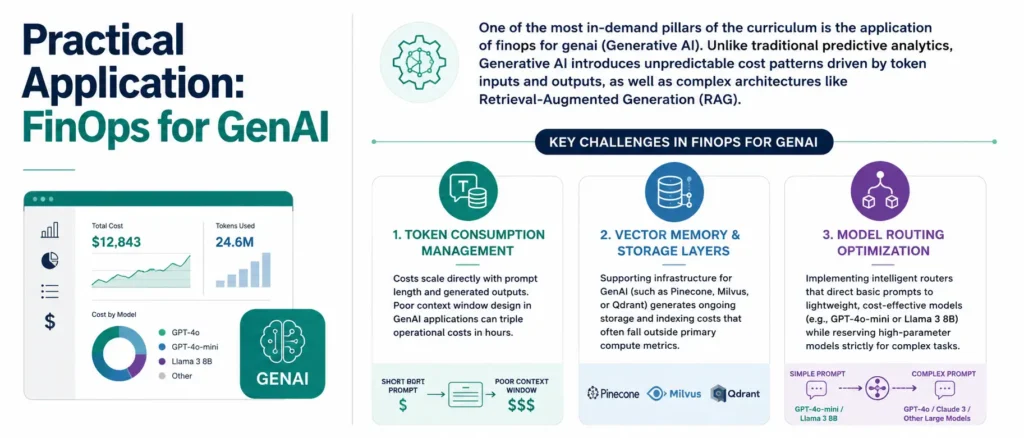
One of the most in-demand pillars of the curriculum is the application of finops for genai (Generative AI). Unlike traditional predictive analytics, Generative AI introduces unpredictable cost patterns driven by token inputs and outputs, as well as complex architectures like Retrieval-Augmented Generation (RAG).
Key Challenges in FinOps for GenAI
-
Token Consumption Management: Costs scale directly with prompt length and generated outputs. Poor context window design in GenAI applications can triple operational costs in hours.
-
Vector Memory & Storage Layers: Supporting infrastructure for GenAI (such as Pinecone, Milvus, or Qdrant) generates ongoing storage and indexing costs that often fall outside primary compute metrics.
-
Model Routing Optimization: Implementing intelligent routers that direct basic prompts to lightweight, cost-effective models (e.g., GPT-4o-mini or Llama 3 8B) while reserving high-parameter models strictly for complex tasks.
Pricing, Bundles, and Registration Details
Individual registration for the self-paced FinOps Certified: AI Value course costs $500 USD. Promotional launch discounts of up to 20% have been made available by the foundation using codes such as FINOPSWEEKLY_20. Purchase grants 12 months of access to the learning platform and includes up to three exam attempts.
For professionals or organizations planning a broader learning path, the FinOps Foundation offers tiered bundle options:
Course and Bundle Pricing Structure
| Bundle Name | Included Certifications & Courses | List Price (USD) |
| Single Course | FinOps Certified: AI Value (Course + Exam) | $500 |
| Specialized Duo Bundle | AI Value + Technology Value | $700 |
| Value Trio Bundle | AI Value + Technology Value + Professional | $1,100 |
| Multi-Specialization Bundle | AI Value + Technology Value + FinOps Certified FOCUS Analyst + Professional | $1,300 |
| Practitioner Full Path | Practitioner + AI Value + Technology Value + FOCUS Analyst + Professional | $1,700 |
| All-Access Subscription | Practitioner + Engineer + AI Value + Technology Value + FOCUS Analyst + Professional + Containers | $2,495 |
Integration with FinOps Certified FOCUS Analyst
Within the training ecosystem, pairing this path with the finops certified focus analyst credential is a standout strategy. The FOCUS™ (FinOps Open Cost and Usage Specification) standard aims to normalize billing data across multiple cloud vendors and SaaS services.
FOCUS Impact on AI: Combining AI Value and FOCUS Analyst enables practitioners to normalize fragmented billing data from AWS, Azure, Google Cloud, OpenAI, and Anthropic into a single open specification, simplifying the creation of unified finops ai dashboards.
Credential Validity and Recognition
Upon passing the final exam, candidates earn a certification valid for 24 months (2 years).
Alongside the credential, a digitally verifiable certificate and a Credly digital badge are issued for professional networking platforms. To maintain active status, professionals must complete a recertification process after two years.
- Exam Passed
- Credly Digital Badge (Valid for 24 Months)
- Recertification Process (At 2 years)
Audience Profile and Prerequisites
The program is tailored for roles operating at the intersection of cloud finance, software engineering, and product management.
Key Target Roles
-
FinOps Practitioners: Looking to expand their scope to cover emerging AI workloads.
-
IT Financial Analysts: Seeking to interpret non-linear billing patterns unique to AI infrastructure.
-
Cloud Architects & DevOps Engineers: Designing foundational environments for ML models and GPU clusters.
-
AI Product Managers: Responsible for protecting gross margins on AI-driven products.
-
Procurement & Sourcing Teams: Negotiating enterprise contracts with AI and model providers.
Prerequisites and Career Pathing
The FinOps Foundation does not require any prerequisite certifications to register for the course. However, prior familiarity with general FinOps principles is strongly recommended, such as holding the FinOps Certified Practitioner (FOCP) or FinOps Certified Engineer (FOCE) credentials.
Note that FinOps Certified: AI Value serves as a mandatory prerequisite for candidates aiming to take the FinOps Certified Professional exam, the highest-ranking credential in the foundation’s hierarchy.
Emerging Career Roles
Acquiring expertise in AI cloud economics provides a strong competitive edge as AI cost control becomes a top executive priority.
The course prepares professionals for specialized roles such as:
-
AI FinOps Consultant: Auditing and optimizing generative AI expenditure across enterprises or consulting practices.
-
Lead FinOps Practitioner / Cloud Financial Architect: Managing complex IT budgets across hybrid cloud and specialized acceleration hardware.
-
Platform Engineer / AI Operations Manager: Balancing processing capacity and GPU allocations against strict project budgets.
Salary Insights and Corporate Value
Specializing in advanced workload cost management offers quantifiable career advantages:
- Entry/ General Cloud Engineer (+10% to 20% Salary Premium) with Intermediate FinOps Certification
- Senior FinOps Roles (US): $180,000 USD/year
- Executive FinOps Roles (Fortune 500): $200.000 - $280.000 USD/year
For consulting firms and managed service providers seeking corporate designations (FinOps Certified Service Provider or FinOps Certified Platform), certified staff members in AI Value count 1:1 alongside the standard Practitioner certification toward corporate staffing requirements.
FinOps Certified: AI Value Discount Code
We are excited to announce that the FinOps Foundation has partnered with FinOps Weekly to offer an exclusive 20% discount on all FinOps certifications for our readers using our code FINOPSWEEKLY_20
You can use our dedicated community finops certified practitioner discount code at checkout to save instantly on your exam enrollment.
Discount Code: FINOPSWEEKLY_20
How to Pass the FinOps Certified: AI Value Exam
Passing the certification exam requires a balanced understanding of core FinOps principles, AI workload economics, and practical scenario evaluation. While the course is self-paced, leveraging a structured study strategy will significantly increase your chances of passing on your first attempt.
1. Master the Architectural Concepts & Terminology
The exam heavily tests your ability to distinguish between traditional cloud mechanics and AI-specific cost drivers. Make sure you can clearly articulate:
-
Training vs. Inference: Understand the different financial profiles of model training (high-burst, GPU-heavy compute) versus inference (continuous, usage-driven, token-based).
-
Token Dynamics: Know how prompt length, output tokens, and context window sizes directly impact invoicing.
-
Supporting Infrastructure: Review how non-compute components—such as vector databases, data pipelines, and fine-tuning storage—contribute to the total cost of ownership (TCO).
2. Focus Heavily on Unit Economics
Expect multiple-choice scenarios that test your capability to align AI spending with business outcomes. Be prepared to identify the correct key performance indicators (KPIs) for different business models:
-
Cost per customer query / resolved ticket.
-
Cost per generated artifact or document processing cycle.
-
Gross margin impact of embedding GenAI features into a SaaS product.
3. Understand "Model Routing" & Architecture Trade-Offs
A core theme of Level 3 is workload placement. You should be comfortable evaluating trade-offs between:
-
Proprietary LLM APIs (e.g., OpenAI, Anthropic) vs. Self-Hosted Open Models (e.g., Llama on dedicated GPU instances).
-
Using small, specialized models for high-frequency queries versus routing complex requests to expensive, high-parameter models.
4. Exam Day Tactics
- Pacing: The exam is cumulative and timed. Do not linger on complex scenario questions; flag them and return after completing straightforward conceptual questions.
- Open-Book Strategy: Since the exam permits reference materials, organize your notes by Level (Visibility, Governance, Optimization) and keep key framework diagrams easily accessible.
Recommended Study Resources & Further Reading
To supplement the official course material and build a well-rounded understanding of AI cloud economics, explore the following curated resources:
Official Framework & Specifications
FinOps Foundation AI Working Group: Access the latest community guides, whitepapers, and real-world case studies directly published by the FinOps Foundation’s dedicated AI working group (finops.org).
FOCUS™ Specification (FinOps Open Cost and Usage Specification): Review the open-source data schema to understand how AI-specific billing metrics are standardized across multi-cloud and SaaS environments (focus.finops.org).
Technical & Business Deep Dives
Cloud Provider AI Pricing Calculator Guides: Familiarize yourself with how major cloud providers structure AI/ML pricing:
AWS Bedrock & SageMaker Pricing Models
Azure OpenAI & AI Search Billing Docs
Google Cloud Vertex AI Cost Structure
FinOps Weekly Podcast: Listen to episodes featuring cloud financial managers discussing the real-world operational challenges of managing GPU allocations and LLM budgets.
Community & Discussion Platforms
- FinOps Weekly Open Source Tools: Discover a wide selection of completely free FinOps tools.
- AWS Well-Architected Cost Optimization Labs: Hands-on laboratories demonstrating practical implementation of AWS cost optimization strategies and Well-Architected best practices.
- FinOps Community Slack: Join FinOps Weekly Slack channels to discuss technical concepts with active practitioners.
Frequently Asked Questions
What is the main difference between FinOps Certified: AI Value and the standard FinOps Certified Practitioner (FOCP)?
The standard FOCP focuses on foundational cloud financial management for traditional Infrastructure as a Service (IaaS) and Platform as a Service (PaaS) workloads (e.g., VMs, block storage, databases). FinOps Certified: AI Value is a specialized intermediate credential that addresses the unique financial complexity of AI and Generative AI, including token-based pricing models, GPU cluster economics, vector memory layers, and AI SaaS integrations.
Do I need to hold the FinOps Certified Practitioner (FOCP) credential before taking the AI Value course?
No, there are no mandatory prerequisites to enroll in or complete the FinOps Certified: AI Value course. However, the FinOps Foundation strongly recommends having prior familiarity with the core FinOps Framework (Inform, Optimize, Operate).
Is FinOps Certified: AI Value required for higher-level certifications?
Yes. Obtaining the FinOps Certified: AI Value credential acts as an official prerequisite for professionals aiming to take the FinOps Certified Professional exam, the highest-ranking designation offered by the FinOps Foundation.
How long is the certification valid, and how does recertification work?
The certification is valid for 24 months (2 years) from the date you pass the exam. Upon passing, you receive an official Credly digital badge. To maintain active status after two years, you must complete the recertification process designated by the FinOps Foundation.
How much does the exam cost, and how many attempts do I get?
The standalone course and exam cost $500 USD (with promotional codes like FINOPSWEEKLY_20 offering up to 20% off during launch phases). Purchase grants 12 months of access to the self-paced learning portal and includes up to 3 exam attempts.
What is the role of the FOCUS™ specification in AI FinOps?
The FOCUS™ (FinOps Open Cost and Usage Specification) standard normalizes billing datasets across different cloud vendors and AI providers. Combining AI Value concepts with FOCUS Analyst methodologies allows organizations to aggregate disparate billing data from vendors like AWS, Azure, GCP, OpenAI, and Anthropic into a single unified dashboard.
Is the course suitable for technical roles, or is it strictly for financial managers?
The curriculum is designed for cross-functional teams. While it is less focused on writing code, it provides immense value for Cloud Architects, Platform Engineers, and DevOps leads who need to design cost-aware AI architectures (e.g., model routing, GPU commitment strategies) alongside Product Managers and IT Financial Analysts.
The FinOps Certified: AI Value certification has established itself as an essential framework for navigating the economic complexities of artificial intelligence in the cloud. By shifting the conversation from cost restriction to business value creation, it bridges the gap between AI engineering and financial stewardship.
For professionals aiming to advance their careers in cloud finance and engineering, as well as enterprises managing AI expenditure, this credential provides a structured, vendor-neutral methodology aligned with modern technology management needs.