AI Cost Management & FinOps: From Executive Blind Spots to Operational Governance
The rapid integration of Generative AI (GenAI) and Large Language Models (LLMs) has transitioned from an experimental innovation project into one of the heaviest and most complex budget lines across enterprise IT.
What was managed just two years ago as a minor SaaS subscription or isolated lab expense has become a recurring cost exceeding $1 million per month for 20% of large enterprises in 2026. Furthermore, two out of three organizations now spend over $250,000 monthly on AI-related infrastructure and services.
At this scale, AI expenditure stops behaving like a simple software tool cost and transforms into a major capital decision. However, the organizational infrastructure required for cost attribution, governance, and visibility has failed to keep pace with adoption speed.
Global findings from the State of AI in FinOps 2026 report published by Harness, surveying 700 engineering leaders and practitioners across the US, UK, France, Germany, and India, paint a stark picture: spending is accelerating across all fronts while leadership operates largely blindfolded.
1. AI Budget Surge: Simultaneous Expansion Across Multiple Providers
Unlike previous cloud adoption cycles, where organizations migrated workloads sequentially (compute, storage, databases), AI cost expansion is occurring simultaneously across every technological layer.
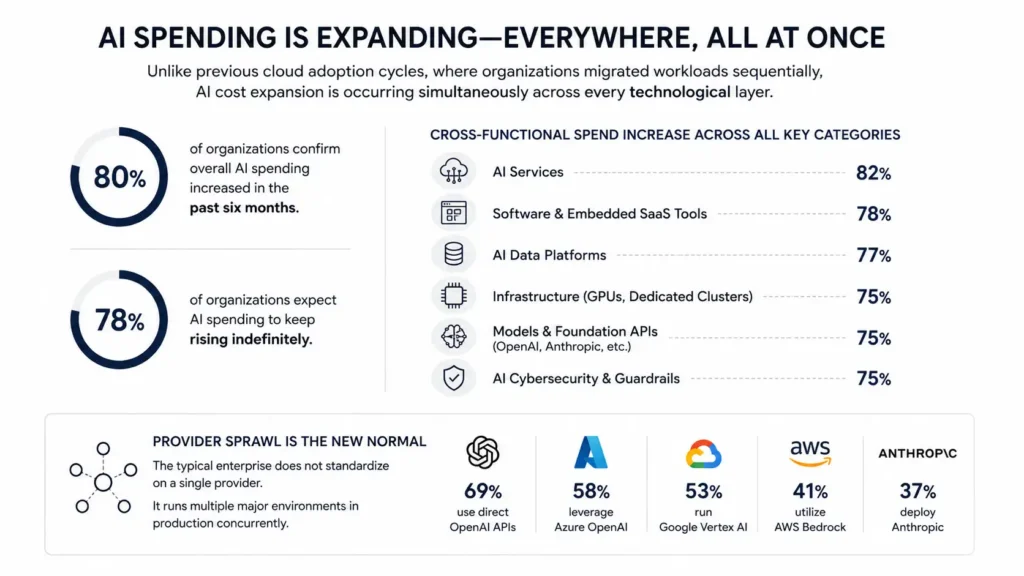
80% of organizations confirm that overall AI spending increased over the past six months, with 78% expecting it to keep rising indefinitely.
This cross-functional spend increase spans all key categories:
- AI Services: 82%
- Software & Embedded SaaS Tools: 78%
- AI Data Platforms: 77%
- Infrastructure (GPUs, Dedicated Clusters): 75%
- Models & Foundation APIs (OpenAI, Anthropic, etc.): 75%
- AI Cybersecurity & Guardrails: 75%
Compounding this growth is the reality of Provider Sprawl.
The typical enterprise does not standardize on a single provider; instead, it runs multiple major environments in production concurrently.
Currently:
- 69% use direct OpenAI APIs
- 58% leverage Azure OpenAI
- 53% run Google Vertex AI
- 41% utilize AWS Bedrock
- 37% deploy Anthropic
Each provider employs distinct billing metrics (input/output tokens, reserved GPU instance hours, per-user seat licenses, rate limits), making a unified single-pane cost dashboard nearly impossible without dedicated FinOps infrastructure.
2. Ownership Crisis: Fragmented Accountability
The root cause of unchecked AI expenditures isn’t merely the rate of spending, but rather structural diffusion of responsibility.
Over half of respondents (52%) state that there is no clear, dedicated owner of AI costs in their organization.
Financial accountability is split four ways, leaving no single team in charge of the total invoice.
A severe structural disconnect exists: engineering and platform teams hold 35% of the influence over cost-driving decisions (model selection, prompt architecture, retry logic), yet Platform/DevOps is accountable for 30% and FinOps for 27%. When the teams making spend-generating decisions don’t feel the budgetary consequences, governance collapses.
| Department / Role | Perceived Cost Accountability | Direct Spending Influence |
|---|---|---|
| Platform / DevOps Teams | 30% | Infrastructure provisioning influence |
| Dedicated FinOps Teams | 27% | Monitoring without code-level veto power |
| Finance (CFO Office) | 23% | Post-facto invoice processing |
| Software / Product Engineering | 19% | 35% direct influence on spending |
3. Operational Opacity, Invoice Shock & Diagnosis Delays
The combination of provider sprawl and diffused ownership creates a dangerous visibility gap.
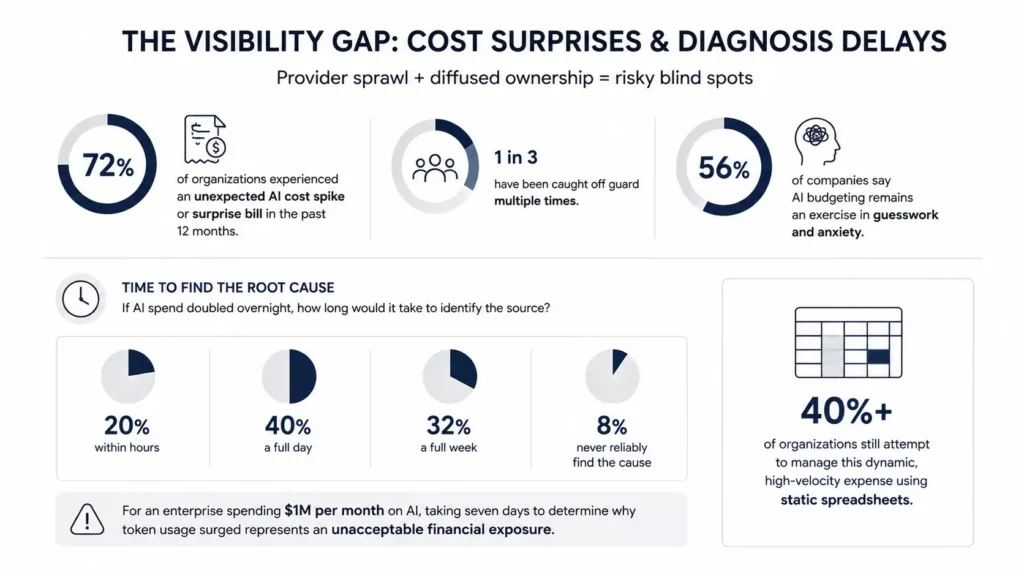
- 72% of organizations experienced an unexpected AI cost spike or surprise bill during the past 12 months.
- 1 in 3 have been caught off guard multiple times.
- 56% admit AI budgeting remains an exercise in guesswork and anxiety.
The true business risk lies in the time required to trace an anomaly back to its root cause.
If an organization’s AI spend doubled overnight:
- Only 20% could identify the source within hours.
- 40% would need a full day.
- 32% would require an entire week of investigation.
- 8% would never reliably find the cause.
For an enterprise spending $1 million per month on AI, taking seven days to determine why token usage surged represents an unacceptable financial exposure.
Yet, over 40% of organizations still attempt to manage this dynamic, high-velocity expense using static spreadsheets.
4. “Tokenmaxxing” Trap & Structural AI Waste
Organizational incentives have actively fueled waste.
In the early adoption phase, enterprises encouraged employees to maximize AI usage to build habits, a trend known as tokenmaxxing.
57% of survey respondents admit their organization actively encourages maximizing AI usage regardless of tangible business return.
In the absence of cost signals during development, this leads to massive waste:
- Organizations estimate that 26% of all AI spend is wasted.
- A $500,000 monthly AI budget wastes approximately $130,000 every month.
- A $1,000,000 monthly budget loses around $260,000 every month with zero return.
This is not an issue of developer apathy.
While 56% of engineering leaders say teams don’t build with cost in mind, only 45% of engineers actually know what their code costs to run.
If an engineer cannot see the price difference between GPT-4o and a lighter model within their IDE or CI/CD pipeline, architectural decisions will inevitably prioritize capability over financial efficiency.
5. Enforcement Gap: Written Policies vs. Execution
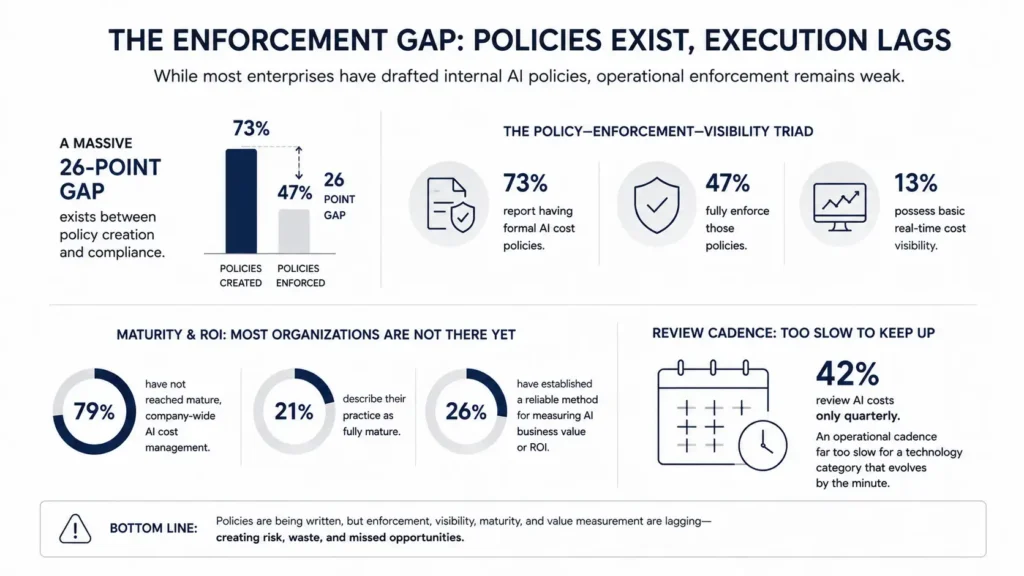
While most enterprises have drafted internal AI policies, operational enforcement remains weak.
A massive 26-point gap exists between policy creation and compliance.
- 73% report having formal AI cost policies.
- Only 47% fully enforce those policies.
- Just 13% possess basic real-time cost visibility.
Consequently:
- 79% have not reached mature, company-wide AI cost management.
- Only 21% describe their practice as fully mature.
- Just 26% have established a reliable method for measuring AI business value or ROI.
Furthermore, 42% review AI costs only quarterly, an operational cadence far too slow for a technology category that evolves by the minute.
6. Roadmap: Implementing AI FinOps & Tokenomics in 2026
To overcome operational paralysis and transform unchecked spending into a sustainable competitive advantage, enterprises should adopt a structured four-step AI Tokenomics framework.
Assign Clear Ownership First
Before procuring tooling, designate a joint FinOps–Platform Engineering lead with explicit authority over AI budgets and cross-department accountability.
Establish a Single Cost View
Normalize multi-provider billing streams (Azure, AWS, OpenAI, Anthropic) into a unified attribution schema categorized by team, application, and feature.
Shift Cost Visibility Left
Embed real-time token pricing and cost estimates directly into engineering IDEs and CI/CD workflows. Developers should understand the financial impact of prompt designs, model selections, and retry loops before deploying to production.
Define Business Unit Economics
Move away from vague global ROI metrics and instead focus on granular unit economics such as:
- AI cost per resolved support ticket
- AI cost per active user
- AI cost per pull request generated
Artificial Intelligence is the most transformative platform shift of the decade, but its long-term profitability depends on financial governance.
Treating AI cost management as a post-invoice accounting exercise guarantees margin erosion.
High-performing organizations in 2026 treat financial efficiency as a core architectural design principle during software development.