
Technical and Strategic Analysis of the FinOps Certified FOCUS Analyst
The FinOps Certified FOCUS Analyst credential is an intermediate-level professional certification developed by the FinOps Foundation. It validates the technical competency required to work with the FOCUS™ (FinOps Open Cost and Usage Specification) standard. This open specification normalizes billing schemas, taxonomies, and usage metrics across major Cloud Service Providers (CSPs), SaaS platforms, and managed service vendors.
Table of Contents
Nature, Purpose, and Scope of the Credential
Far from being a simple certificate of attendance, this exam-based certification validates practical skills in ingesting, transforming, validating, and interpreting standard-compliant datasets. Its core objective is to resolve structural and terminological fragmentation across multi-cloud environments, enabling engineering, finance, and operations teams to collaborate on a single source of truth.
Within the FinOps Foundation certification pathway, it serves two primary functions:
Career Progression: It is a mandatory prerequisite for the advanced FinOps Certified Professional examination.
Organizational Conformity: Enterprises applying for the FinOps Certified FOCUS Conformant partner designation must employ a minimum quota of certified analysts based on company size:
| Organization Size (Employees) | Minimum Required Certified FOCUS Analysts |
| 5,000 or more | 10 certified analysts |
| 500 – 4,999 | 5 certified analysts |
| 100 – 499 | 3 certified analysts |
| Fewer than 100 | 2 certified analysts |
FOCUS Architecture and Multi-Cloud Billing Challenges
Multi-cloud operations often result in disparate billing data exports across AWS, Azure, GCP, and OCI, creating high ETL maintenance overhead and financial reconciliation risks. FOCUS resolves these operational frictions through unified data modeling.
| Analytical Dimension | Traditional Multi-Vendor Approach | FOCUS Standard | Operational & Financial Impact |
| Amortized Cost Treatment | Disparate columns and formulas (AmortizedCost, EffectiveCost, UnblendedCost). |
Unified EffectiveCost column with explicit amortized distribution. |
Mathematical consistency in chargeback and cost center allocation. |
| Charge Classification | Proprietary terminology (Usage, Purchase, Credit, Tax, Rounding). |
Standardized taxonomy under the ChargeCategory dimension. |
Universal aggregation rules independent of the underlying vendor. |
| Time Boundaries | Mixed usage and billing dates in non-standard fields. | Strict separation between ChargePeriod and BillingPeriod. |
Seamless reconciliation across cash-basis and accrual-basis accounting. |
| Querying & Reporting | CSP-specific SQL syntax and custom schema mapping. | Standardized queries from the FOCUS Use Case Library. | Direct dashboard and query portability across data warehouses. |
Curriculum Structure and Module Breakdown
The official curriculum is self-paced and requires approximately 5 to 6 hours of coursework across eight modules:
Module 1: Introduction to FinOps Certified FOCUS Analyst.
Module 2: FOCUS & The FinOps Framework.
Module 3: Reading and Interpreting the Specification (Versions v1.0 through v1.4).
Module 4: Specification Attributes (Data architecture, hierarchy, and naming conventions).
Module 5: Specification Columns (BilledCost, EffectiveCost, ChargeCategory, etc.).
Module 6: FOCUS Datasets (Ingestion from BigQuery, Azure Cost Management, AWS, OCI).
Module 7: Best Practices (Leveraging the FOCUS Validator and Use Case Library).
Module 8: Certification Exam.
Certification Exam Parameters
- Certifying Body: The Linux Foundation / FinOps Foundation.
- Technical Level: Intermediate.
- Exam Format: 40 multiple-choice and multi-select questions.
- Duration: 60 minutes (1 hour).
- Delivery Method: Online, unproctored, asynchronous.
- Retake Policy: 3 attempts included per enrollment.
- Passing Score: Approximately 75%.
- Validity & Renewal: Valid for 24 months (includes a Credly digital badge). Recertification is available for $99 USD (extends validity by 12 months).
FinOps for Containers Discount Code
We are excited to announce that the FinOps Foundation has partnered with FinOps Weekly to offer an exclusive 20% discount on all FinOps certifications for our readers using our code FINOPSWEEKLY_20
You can use our dedicated community finops certified practitioner discount code at checkout to save instantly on your exam enrollment.
Discount Code: FINOPSWEEKLY_20
Sample Exam Questions and Technical Analysis
Question 1: Commitment Discount Amortization
An organization purchases a one-year All-Upfront Commitment Discount. In a FOCUS-compliant dataset, how should the BilledCost and EffectiveCost columns be populated on the specific purchasing transaction row (Covering Charge)?
-
A)
BilledCostis set to $0 andEffectiveCostreflects the full upfront amount paid. -
B)
BilledCostreflects the total invoiced amount andEffectiveCostis strictly set to $0. -
C) Both
BilledCostandEffectiveCostreflect the total upfront amount. -
D) The upfront cost is divided evenly across 365 days in
BilledCostwhileEffectiveCostremains null.
Correct Answer: B. In the FOCUS specification, upfront commitment purchases record the cash outflow inBilledCoston the purchase date, whileEffectiveCostremains 0 on that row. The amortized value is recognized incrementally across individual usage rows (ChargeCategory = 'Usage').d
Question 2: Differentiating Billing and Consumption Periods
Which FOCUS temporal dimensions must be queried to satisfy an invoice reconciliation report (cash accounting) versus an operational reliability incident review (accrual consumption), respectively?
-
A)
ChargePeriodStart/Endfor treasury andBillingPeriodStart/Endfor engineering. -
B)
InvoicePeriodStart/Endfor treasury andUsagePeriodStart/Endfor engineering. -
C)
BillingPeriodStart/BillingPeriodEndfor treasury andChargePeriodStart/ChargePeriodEndfor engineering. -
D)
ContractPeriodStart/Endfor treasury andEventPeriodStart/Endfor engineering.
Correct Answer: C.BillingPerioddefines the commercial invoice cycle, whereasChargePeriodpinpoints the precise UTC timestamp interval during which resource consumption occurred.
Question 3: Schema Governance and Column Ordering
According to FOCUS schema architectural guidelines, which statement accurately describes dataset ordering and naming conventions?
-
A) Extended provider-specific columns must precede standard FOCUS columns.
-
B) Arbitrary abbreviations should be used extensively across all column headers.
-
C) Standard FOCUS columns must be placed before custom provider columns, and arbitrary abbreviations are prohibited except for explicit terms like
Sku. -
D) Amortized cost fields must retain legacy naming conventions such as
AmortizedCost. -
Correct Answer: C. The specification mandates standard normative columns to appear first, standardizes naming conventions (replacing
AmortizedCostwithEffectiveCost), and restricts arbitrary abbreviations.
Question 4: Measuring Unused Commitment Capacity
Which combination of filters and metric columns correctly calculates the financial waste of unutilized commitment discounts within a monthly dataset?
-
A) Filter by
BilledCost = 0and group byProviderName. -
B) Filter by
CommitmentDiscountStatus = 'Unused'and aggregate the sum ofEffectiveCost. -
C) Aggregate
BilledCostwhereCommitmentDiscountIdis null. -
D) Filter by
ChargeCategory = 'Usage'and exclude rows whereEffectiveCost > 0. -
Correct Answer: B. Unutilized commitment discount value is tracked on dedicated rows where
CommitmentDiscountStatus = 'Unused', with the monetary loss reflected inEffectiveCost.
Question 5: Utilizing the FOCUS Use Case Library
What is the primary operational role of the FOCUS Use Case Library within an enterprise FinOps practice?
-
A) Providing Terraform infrastructure-as-code modules for automated provisioning.
-
B) Providing a centralized repository of validated SQL queries tailored to common FinOps reporting requirements.
-
C) Serving as a payment gateway for direct CSP settlements.
-
D) Managing commercial software license tracking.
Correct Answer: B. The repository provides standardized, multi-cloud SQL templates to measure effective savings rates, commitment coverage, and unit economics across AWS, Azure, GCP, and OCI data exports.
Introductory Course and Free Learning Path
For professionals seeking a foundational overview before formal certification, the FinOps Foundation offers the self-paced Introduction to FOCUS course ($0 USD, approximately 1 hour on learn.finops.org). While completing this introductory module provides a Certificate of Completion, earning the formal FinOps Certified FOCUS Analyst title requires passing the official 40-question proctored evaluation.
Pricing Structure, Discount Codes, and Financial Aid
| Program / Option | Official List Price (USD) | Included Components |
| Introduction to FOCUS | $0 (Free) | Introductory course module and Certificate of Completion. |
| FinOps Certified FOCUS Analyst | $400 | Full course (12-month access), certification exam (3 attempts), Credly badge. |
| FOCUS Analyst – Recertification | $99 | Updated course material access and 12-month validity extension exam. |
| Bundle: Practitioner + FOCUS Analyst | $600 | Practitioner and FOCUS Analyst courses and exams (Saves $300 USD). |
| Bundle: Engineer + FOCUS Analyst | $600 | Certified Engineer and FOCUS Analyst courses and exams. |
| Comprehensive 5-Certification Bundle | $1,700 | Includes Practitioner, AI Value, Tech Value, FOCUS Analyst, and Professional. |
Discounts and Scholarship Programs
FinOps Focus Analyst Certification
We are excited to announce that the FinOps Foundation has partnered with FinOps Weekly to offer an exclusive 20% discount on all FinOps certifications for our readers using our code FINOPSWEEKLY_20
You can use our dedicated community finops certified practitioner discount code at checkout to save instantly on your exam enrollment.
Discount Code: FINOPSWEEKLY_20
Professional & Concise Study Summary
Preparing for the FinOps Certified FOCUS Analyst certification requires shifting from a traditional multi-cloud approach to a native data normalization mindset. An effective study plan is structured across three key stages over the course of a week:
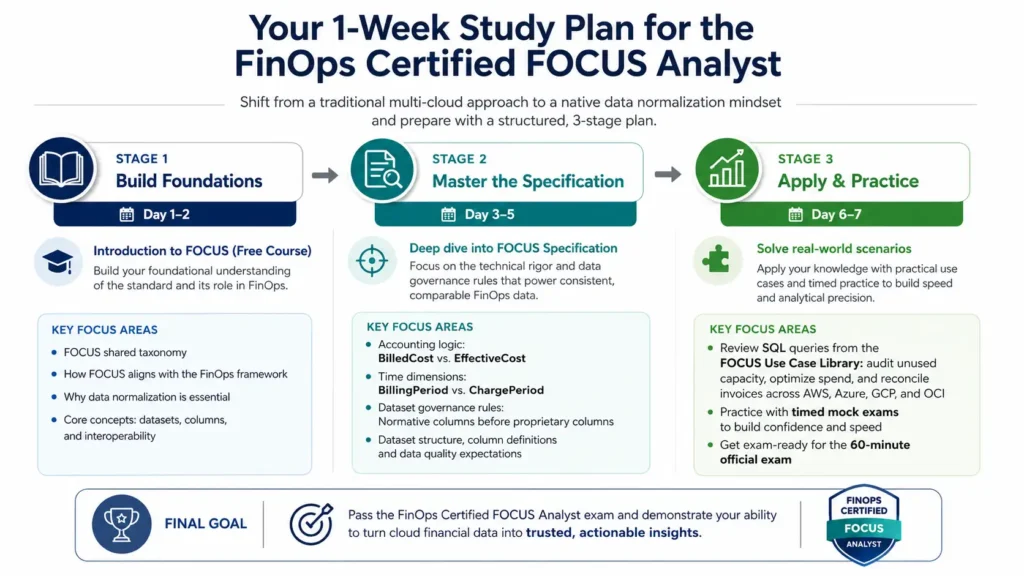
Start by building foundational knowledge with the free Introduction to FOCUS course, ideal for understanding the shared taxonomy and how the standard aligns with the broader FinOps framework. Next, focus the core of your preparation on the technical rigor of the specification (v1.0 to v1.4): mastering the accounting logic between BilledCost and EffectiveCost, distinguishing BillingPeriod from ChargePeriod, and learning dataset governance rules (such as placing normative columns before proprietary ones).
The final phase involves applying this knowledge to real-world scenarios. Reviewing SQL queries from the FOCUS Use Case Library to audit unused capacity or reconcile invoices across AWS, Azure, GCP, and OCI, combined with timed practice exams, will give you the speed and analytical precision needed to clear the 60-minute official exam.
Frequently Asked Questions
What is the FOCUS™ specification, and who backs it?
It is an open-source data specification governed by the FinOps Foundation (part of The Linux Foundation) that standardizes billing taxonomies, cost metrics, and usage schemas across cloud service providers (AWS, Azure, GCP, OCI) and SaaS platforms into a unified format.
Are there any formal prerequisites before taking the exam?
There are no mandatory certification prerequisites to enroll. However, completing the free Introduction to FOCUS course and possessing a foundational understanding of data analysis and the core FinOps lifecycle is strongly recommended.
Is this credential required for advanced certifications?
Yes. It is a mandatory prerequisite to qualify for the FinOps Certified Professional exam. Additionally, technology vendors and service providers must employ certified analysts to achieve the organizational FinOps Certified FOCUS Conformant partner status.
What is the exam format, duration, and passing score?
The exam consists of 40 multiple-choice and multi-select questions delivered in English. It has a 60-minute time limit, is taken online in an unproctored/asynchronous format, and requires an approximate passing score of 75%. Enrollment includes up to 3 exam attempts within a 12-month access window.
What is the key technical difference between BilledCost and EffectiveCost?
BilledCost records the actual cash flow invoiced on the transaction date (cash-basis accounting, such as an upfront commitment purchase). EffectiveCost represents the amortized economic cost distributed proportionally across actual resource consumption (accrual-basis accounting), registering as $0 on the initial commitment purchase row.
How do BillingPeriod and ChargePeriod differ in dataset queries?
BillingPeriod defines the commercial invoice cycle and tax boundary set by the provider, whereas ChargePeriod defines the exact UTC time range during which the underlying resource was provisioned or consumed.
What is the pricing structure and available discount options?
The individual certification costs $400 USD. Multi-certification bundles (such as pairing with Practitioner or Engineer for $600 USD), The Linux Foundation Training Scholarship Fund, and active community discount codes can be applied at checkout on learn.finops.org.
How long is the certification valid, and what is the renewal policy?
The credential is valid for 24 months (2 years) from the date of passing and comes with a verified digital badge via Credly. It can be extended for an additional 12 months by passing the recertification exam for $99 USD.