
From Cloud Start to Power Play: Mapping FinOps Maturity Across the Cloud Journey

Every organisation that moves to the cloud eventually discovers the same truth: agility and scalability come bundled with a financial complexity that does not announce itself until the first surprising invoice arrives. FinOps exists to close that gap, blending financial discipline with cloud operations so that spend and value stay in proportion to one another. What often gets missed is that FinOps is not a single destination; it is a journey that looks meaningfully different depending on how far along that journey an organisation happens to be.
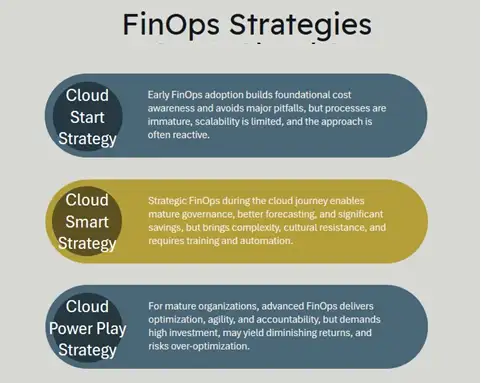
FinOps maturity typically unfolds across three recognisable strategic stages.
Cloud Start: Laying the Foundation
In the earliest days of cloud adoption, enthusiasm tends to outrun process. Teams provision resources quickly, experiment freely, and rarely pause to ask what any of it costs until finance does the asking for them. The Cloud Start strategy meets organisations where they are: standing up basic billing dashboards, introducing simple cost-reporting tools, and getting engineering and finance into the same conversation for perhaps the first time. Tagging resources and setting rudimentary budget alerts do most of the heavy lifting at this stage. The upside is real; a culture of cost-consciousness starts to take root, and the most obvious sources of waste get caught early. The downside is equally real: tools remain immature, historical data is thin, and much of the effort still feels reactive rather than planned.
Cloud Smart: Where Sophistication Meets Scale
As cloud usage stabilises and spans more teams, organisations enter what is often called the Cloud Smart phase. Usage patterns become predictable enough to forecast with confidence, governance frameworks begin to take shape, and automated cost allocation replaces manual spreadsheet gymnastics. Chargeback and showback models mature, engineering teams gain access to granular analytics they can actually act on, and cross-functional groups start hunting for savings through reserved instances, savings plans, and better-negotiated contracts. The gains here are substantial: sharper visibility, stronger alignment between cloud spend and business goals, and real opportunities for cost reduction. This stage is not free of friction, however; the investment required in tooling and training is significant, and the added complexity can occasionally slow decision-making rather than speed it up.
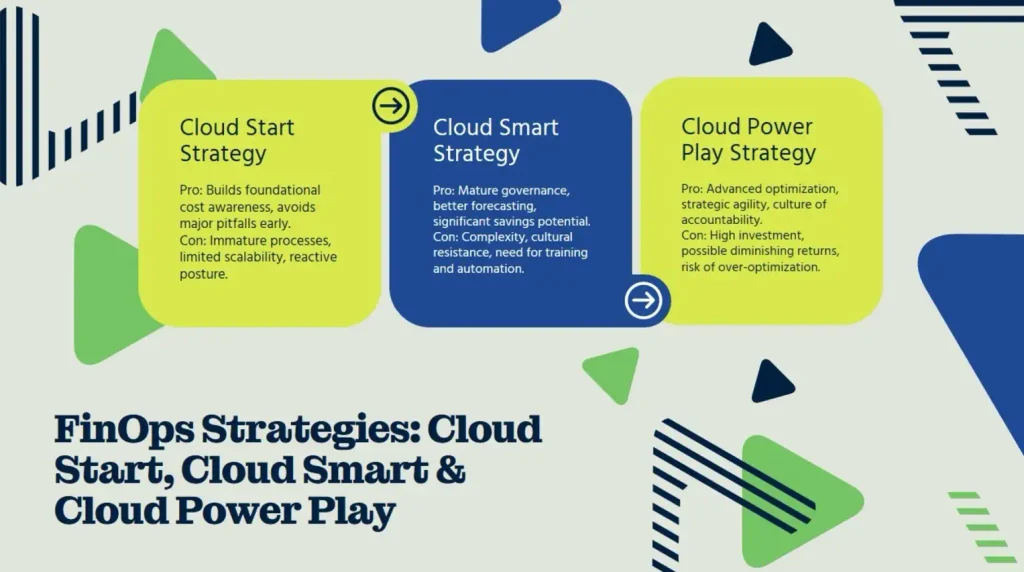
Each FinOps strategy carries its own balance of advantages and trade-offs.
Cloud Power Play: Optimisation as Culture
Organisations that have been in the cloud long enough to fully understand their own cost drivers eventually reach the Cloud Power Play stage, where FinOps stops being a management exercise and becomes a genuine source of competitive advantage. Advanced analytics, machine-learning-driven forecasting, and benchmarking against industry peers become routine. Every team owns its spend, and cost optimisation is embedded in the culture rather than bolted on as an afterthought. The rewards at this stage are considerable: maximum efficiency, the agility to adopt new cloud offerings quickly, and a strong culture of accountability. The risks are subtler; returns on further optimisation start to diminish, and there is a genuine danger of over-optimising to the point where flexibility and innovation begin to suffer.
Why the Distinction Matters
None of these three stages is inherently superior to another; each simply reflects where an organisation stands in its cloud maturity, and each carries its own trade-offs. The mistake most organisations make is not choosing the wrong stage; it is assuming the stage they are in is permanent, or worse, attempting to skip straight to Cloud Power Play tooling without the foundational visibility that Cloud Start and Cloud Smart are meant to establish. FinOps maturity, like most organisational change, rewards patience and sequencing far more than it rewards ambition alone.
Conclusion
FinOps was never meant to be a single framework applied uniformly on day one. It is a partnership between finance, engineering, and business teams that deepens as the organisation’s own cloud fluency deepens. Whether a team is setting up its first billing dashboard or benchmarking against industry peers, the goal remains the same: make sure spend and value never drift too far apart.
References
- FinOps Foundation Framework – https://www.finops.org/framework/
- FinOps Foundation – Maturity Model – https://www.finops.org/framework/maturity/
- AWS Cloud Economics – https://aws.amazon.com/economics/
- Microsoft Cloud Adoption Framework – https://learn.microsoft.com/en-us/azure/cloud-adoption-framework/
- Google Cloud Architecture Framework – Cost Optimization – https://cloud.google.com/architecture/framework/cost-optimization
