Building the Financial Backbone of Generative AI: A Practical FinOps Blueprint
Generative AI has moved from an intriguing experiment to a genuine line of business for many enterprises, and with that shift comes an obligation that is easy to underestimate: the financial architecture behind it needs to be every bit as deliberate as the technical architecture. AI workloads lean heavily on CPU and GPU capacity, and the cloud providers hosting them, AWS, Azure, and Google Cloud alike, have built out entire service catalogues to support generative use cases. Left unmanaged, the consumption these services generate can quietly outpace the value they are delivering. A FinOps strategy purpose-built for AI is what keeps that relationship in balance.
Cost Transparency: Making the Invisible Visible
The starting point for any credible FinOps strategy is transparency: knowing precisely what is being spent, and why. For AI workloads, that means breaking costs down by the stage of the pipeline that generated them, namely data processing and storage, model training, and inference. Each of these carries a distinct cost profile and a distinct set of optimisation levers, and lumping them together into a single line item makes it almost impossible to know where to intervene.
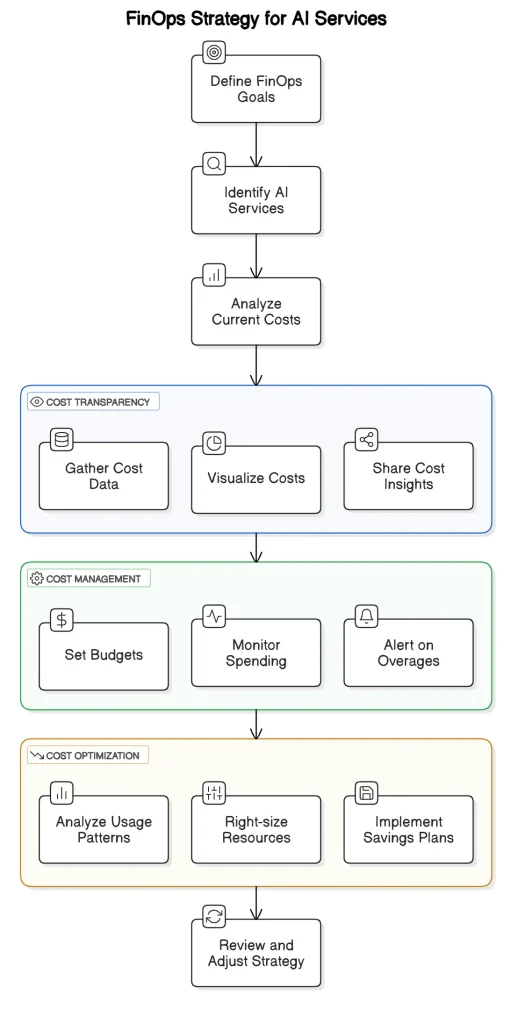
A structured path through cost transparency, management, and optimisation for AI services.
Cost Management: Keeping Spend Inside the Lines
Transparency only matters if it feeds into action. Effective cost management for AI means setting budgets at the level of individual projects, forecasting future spend from historical usage patterns, and configuring automated alerts that fire the moment consumption threatens to breach a threshold. None of this is exotic; it is the same budgetary discipline mature organisations already apply elsewhere, simply pointed at a workload that happens to bill differently.
Cost Optimisation: Getting More Value Per Dollar
Optimisation goes beyond simply staying within budget; it is about extracting more value from every dollar spent. Right-sizing compute resources so they match the actual demands of a given AI task, taking advantage of spot instances for workloads that can tolerate interruption, and scheduling compute-intensive jobs during off-peak windows are all proven, low-friction ways to trim spend without touching model quality.
Why AI Changes the FinOps Equation
AI workloads introduce challenges that traditional cloud FinOps rarely has to contend with. GPU scarcity has made infrastructure availability genuinely volatile, and the accessibility of generative AI tools means that non-technical teams in product, marketing, and sales are now generating cloud costs directly, often without realising it. Pricing itself has diversified well beyond the familiar per-seat software model: some vendors charge by the resource consumed, others by outcome delivered, and still others by the conversation, the minute, or the hour. Salesforce charges per conversation, Microsoft charges by the hour, and newer entrants such as Zendesk tie pricing directly to whether a customer query was successfully resolved. Making sense of this variety is now a core FinOps skill in its own right, not a footnote to it.
A Maturity Model Worth Borrowing
Organisations tend to progress through a recognisable arc as their AI FinOps practice matures. Early on, the focus is simply establishing basic cost tracking. As practices develop, regular budget reviews and cost allocation policies enter the picture. Mature organisations layer in predictive analytics and automation, and the most advanced, the leading cohort, run fully automated cost management with predictive forecasting built in as a matter of course. Getting from one stage to the next requires clear governance, defined ownership across finance, engineering, and operations, and a genuine commitment to continuous improvement rather than a one-off initiative.
Conclusion
A FinOps strategy for generative AI is not a bolt-on compliance exercise; it is the financial discipline that determines whether an AI initiative remains sustainable long after the initial pilot excitement fades. Organisations that build cost transparency, active management, and continuous optimisation into their AI programmes from the outset are the ones that get to keep scaling those programmes, rather than being left to explain why the bill outgrew the budget.
References
- FinOps Foundation – FinOps for AI Overview – https://www.finops.org/wg/finops-for-ai-overview/
- FinOps Foundation – FinOps for AI Topic Hub – https://www.finops.org/topic/finops-for-ai/
- AWS Cloud Financial Management Blog – https://aws.amazon.com/blogs/aws-cloud-financial-management/
- Azure OpenAI Cost Management Guidance – https://learn.microsoft.com/en-us/azure/ai-services/openai/how-to/cost-management
- Google Cloud Vertex AI Pricing – https://cloud.google.com/vertex-ai/pricing