
Full Guide to the FinOps Certified: Technology Value Certification
The rapid evolution of corporate IT architectures has radically transformed the financial management of Information Technology (IT). The traditional view, strictly limited to controlling elastic public cloud spend, is now obsolete.
In this context, the FinOps Foundation created the FinOps Certified: Technology Value accreditation.
This intermediate-level credential directly addresses the urgent need to extend financial governance and cost engineering principles beyond traditional IaaS and PaaS providers (such as AWS, Azure, and GCP) to integrate all domains of enterprise technology investment.
Table of Contents
What is the FinOps Certified: Technology Value Certification?
The core objective of the FinOps Certified: Technology Value credential is to empower technology, finance, and business professionals to define and implement FinOps Scopes.
This methodology structures complex technology portfolios by directly connecting operational consumption with corporate strategy, clear budgetary ownership attribution, and business value measurement.
The Challenge of IT Spend Fragmentation
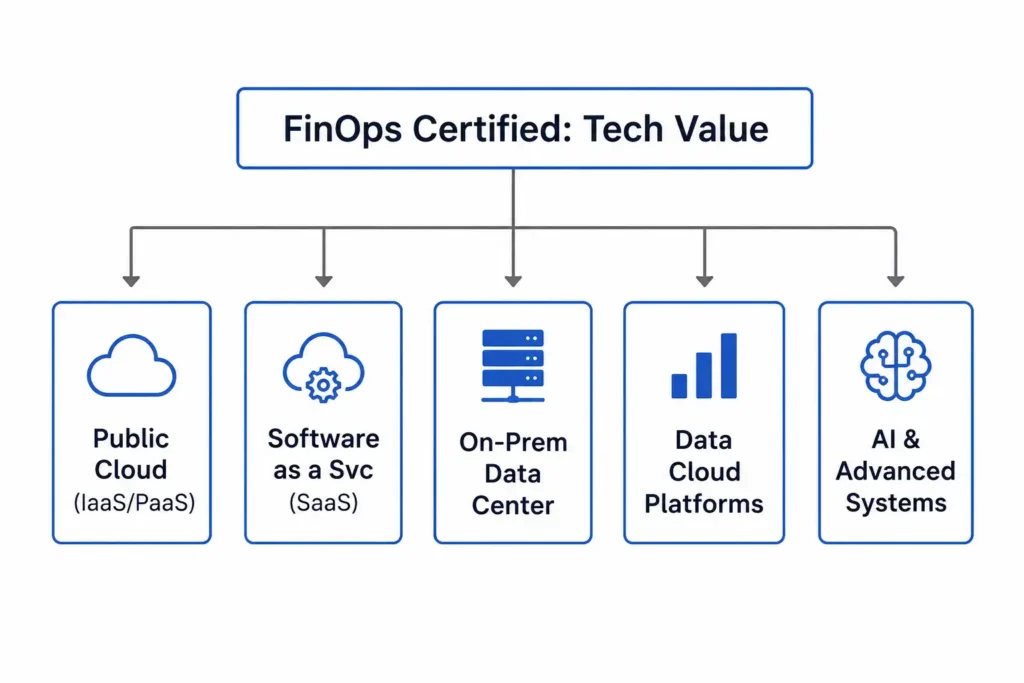
The demand for this framework stems from the growing fragmentation of technology spend in modern enterprises. Today, IT investment extends far beyond elastic infrastructure invoices to encompass a broad matrix of costs:
- Software as a Service (SaaS) Licenses: Analytics tools, ERPs, CRMs, and collaboration platforms.
- Consumption-Based Data Platforms (Data Cloud): Environments like Snowflake, Databricks, or BigQuery.
- On-Premises Infrastructure (Data Center): Local servers, colocation facilities, physical storage, and hardware maintenance contracts.
- Artificial Intelligence Systems: Large Language Models (LLMs), inference infrastructure, and token-based usage.
Through this accreditation, the FinOps discipline evolves from basic cloud waste reduction to a comprehensive practice of Total Cost of Ownership (TCO) and unit economics management.
Certified professionals gain the conceptual and practical skills needed to normalize heterogenous cost models, ensuring technology investments are evaluated using unified criteria for efficiency, operating margins, and return on investment (ROI).
Career Impact, Employability, and Professional Roles
The tech job market increasingly demands professionals who can bridge the gap between engineering, finance, and executive leadership. The FinOps Certified: Technology Value credential validates mastery of a cross-functional financial and technical vocabulary, positioning practitioners to lead cost efficiency initiatives across hybrid and multi-cloud environments.
Earning this certification enables advanced performance across key organizational roles:
| Professional Role | Certification Application Scope | Direct Organizational Impact |
| FinOps Practitioner / Lead | Establishes governance frameworks and budgeting across hybrid infrastructure, SaaS, and analytics platforms. | Eliminates financial visibility gaps and solidifies the corporate FinOps operating model. |
| Cloud Financial Analyst | Builds cost attribution models (showback/chargeback) and tracks unit economics metrics. | Translates complex technical usage data into actionable financial reports for leadership. |
| Solutions Architect | Drives strategic workload placement by embedding cost variables into system architecture. | Designs cost-efficient architectures while evaluating trade-offs between cloud, SaaS, and data centers. |
| Procurement / IT Sourcing Specialist | Governs SaaS contracts, manages renewal windows, and optimizes usage commitments in data platforms. | Reduces contractual risk and leverages real operational usage data to negotiate volume discounts. |
| Infrastructure Directors / CTO / VP of IT | Aligns total IT expenditure with core business goals and key performance indicators (KPIs). | Shifts the executive perception of IT from an unavoidable cost center to a profitable value driver. |
A Mandatory Step Toward FinOps Certified Professional
Within the FinOps Foundation’s learning pathway, holding an active FinOps Certified: Technology Value credential is a mandatory formal prerequisite, alongside the FOCUS Analyst and AI Value certifications, for candidates aiming to take the FinOps Certified Professional exam, the highest distinction in the industry.
FinOps for Containers Discount Code
We are excited to announce that the FinOps Foundation has partnered with FinOps Weekly to offer an exclusive 20% discount on all FinOps certifications for our readers using our code FINOPSWEEKLY_20
You can use our dedicated community finops certified practitioner discount code at checkout to save instantly on your exam enrollment.
Discount Code: FINOPSWEEKLY_20
Curriculum Structure and Exam Requirements
The self-paced study program is delivered through the official FinOps Foundation platform (learn.finops.org) and is structured into six sequential modules.
The course architecture enforces a progression rule: to unlock the final certification exam, students must complete all five theoretical modules and earn each corresponding digital FinOps Trained badge.
- FinOps Trained — Scopes
- FinOps Trained — Public Cloud
- FinOps Trained — SaaS
- FinOps Trained — Data Center
- FinOps Trained — Data Cloud Platforms
- FinOps Certified: Technology Value — Certification Exam
Course enrollment grants 12 months of unlimited access to learning materials and online assessments. Upon passing the final exam, candidates receive a digital diploma with a unique verification code and a digital badge issued via Credly, valid for 24 months. Students are allowed up to three exam attempts during their subscription period.
Syllabus Breakdown
FinOps Trained — Scopes
Evaluated Competencies: Boundary setting, linking expenditure to corporate strategy, and assigning accountability.
Optimization Mechanisms: Budgetary hierarchies and financial responsibility frameworks.
FinOps Trained — Public Cloud
Evaluated Competencies: Applying FinOps capabilities to elastic infrastructure, cost variability, and rate optimization commitments.
Optimization Mechanisms: Reserved Instances (RIs), Savings Plans, resource tagging governance, and rightsizing.
FinOps Trained — SaaS
Evaluated Competencies: Managing decentralized procurement (Shadow IT), unassigned license governance, and managed software agreements.
Optimization Mechanisms: Software license rationalization, active user utilization auditing, and contract renewal management.
FinOps Trained — Data Center
Evaluated Competencies: Capital expenditure (CapEx) modeling, depreciation cycles, capacity planning, and facility overhead costs.
Optimization Mechanisms: Translating CapEx to equivalent operational costs and hardware refresh strategy analysis.
FinOps Trained — Data Cloud Platforms
Evaluated Competencies: Managing consumption-based analytics platforms and shared compute workloads.
Optimization Mechanisms: Credit consumption controls, department-level query attribution, and data efficiency design.
Certification Exam
Evaluated Competencies: Cumulative, domain-spanning final evaluation of the full Technology Value syllabus.
Optimization Mechanisms: Real-world scenario analysis and multi-variable business case resolution.
Pricing Analysis, Bundles, and Promo Codes
Accessing the certification involves fixed individual pricing as well as course bundle options curated by the FinOps Foundation to encourage progression along the learning path.
Pricing Structure and Bundle Comparison
The individual self-paced course and exam attempt costs $500 USD. However, due to the interconnected nature of the curriculum, purchasing bundled packages offers significant savings per credential:
| Registration Option or Bundle | Included Certifications & Exams | Official Price (USD) | Savings vs. Individual Purchase |
| Technology Value (Standalone) | FinOps Certified: Technology Value | $500 USD | — |
| Technology Value + Professional | Tech Value + FinOps Certified Professional | $700 USD | Save $300 USD |
| AI Value + Technology Value | AI Value + FinOps Certified Technology Value | $700 USD | Save $300 USD |
| FOCUS Analyst + Tech Value + Pro | FOCUS Analyst + Tech Value + Professional | $1,050 USD | Save $350 USD |
| AI Value + Tech Value + Pro | AI Value + Tech Value + Professional | $1,100 USD | Save $400 USD |
| AI + Tech Value + FOCUS + Pro | AI Value + Tech Value + FOCUS + Professional | $1,300 USD | Save $600 USD |
| Practitioner + AI + Tech + FOCUS + Pro | Full bundle covering all 5 core certifications | $1,700 USD | Save $700 USD |
| Full Catalog Subscription | Access to the entire FinOps training catalog | $2,495 USD | Varies by usage |
Promotional Discount Strategies and Coupons
To optimize your registration cost on learn.finops.org, several community and institutional mechanisms are available:
FinOps for Containers Discount Code
We are excited to announce that the FinOps Foundation has partnered with FinOps Weekly to offer an exclusive 20% discount on all FinOps certifications for our readers using our code FINOPSWEEKLY_20
You can use our dedicated community finops certified practitioner discount code at checkout to save instantly on your exam enrollment.
Discount Code: FINOPSWEEKLY_20
Official Promotional Events
During International FinOps Day (mid-August), the foundation releases codes like finopsday2026 for 30% off self-paced courses and bundles. Annual campaigns such as Cyber Week and Black Friday (November/December) feature codes like cyber2026 or BLACKFRIDAY, discounting list prices by 25% to 40%.
Corporate Volume Discounts
Organizations looking to train 10 or more employees can request custom corporate rate plans directly via training@finops.org.
Exam Preparation Methodology and Passing Strategies
Passing the cumulative exam requires rigorous conceptual understanding beyond memorizing billing definitions. Candidates must demonstrate analytical decision-making when balancing technical constraints against financial goals.
CapEx vs. OpEx Infrastructure Dynamics
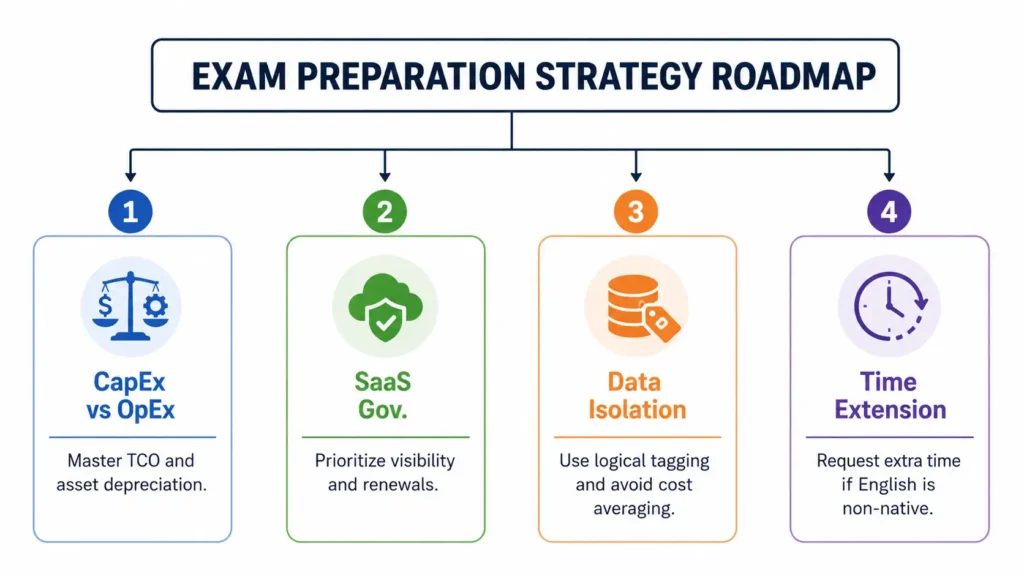
Master the contrast between capital expenditure (CapEx) in data centers — where server depreciation, physical real estate, and utility costs impose fixed long-term commitments — and the variable, operational expenditure (OpEx) model of public cloud platforms. This understanding is essential for answering questions on workload placement and cloud migration ROI.
SaaS Governance Frameworks
In managed software environments, focus on implementing appropriate governance for decentralized purchasing. Exam scenarios favor visibility, active seat audits, and forward-looking contract renewal planning over abrupt punitive actions like immediate software lockouts.
Data Cloud Cost Attribution
Understand the separation of compute and storage in modern data platforms. Successful exam answers emphasize granular resource tagging on virtual compute warehouses and per-query execution tracking, avoiding overly simplified approaches like splitting costs evenly across business units.
Time Management and Testing Mechanics
Review the end-of-module assessments thoroughly, as they highlight knowledge gaps before the final exam. Non-native English speakers should submit a time extension request through the FinOps Foundation support desk prior to starting the test to ensure ample time for reading complex scenario questions.
Exam Practice Scenarios and Questions
To illustrate the format of the final assessment, the following three practice scenarios reflect exam domains samples, along with detailed answer justifications based on the FinOps Framework.
Scenario 1: Financial Governance in Software as a Service (SaaS)
Question: A global enterprise experiences an unbudgeted 40% surge in SaaS software subscriptions caused by various engineering and marketing teams independently buying licenses. Which strategy within the FinOps Scope for SaaS best restores financial control without stalling business agility?
A) Immediately revoke access for all SaaS accounts lacking a central purchase order from the finance team.
B) Implement a discovery process to map license adoption, identify idle users, and consolidate contract renewal timelines.
C) Force the immediate migration of all SaaS applications onto virtual machines hosted in a public cloud IaaS provider.
D) Shift payment responsibilities to employee personal credit cards via monthly expense reports.
Correct Answer: B
Analytical Justification
In SaaS FinOps governance, cutting tool access abruptly disrupts business operations, while re-architecting SaaS applications to IaaS is technically unviable. Option B correctly executes the Inform phase by creating inventory visibility, eliminating unused seats, and organizing renewals to negotiate enterprise volume discounts without hindering team productivity.
Scenario 2: Cost Attribution in Cloud Data Platforms (Data Cloud)
Question: A data science team runs analytical queries on a shared Data Cloud platform where compute resources are pooled globally. The monthly bill shows a single unallocated sum of consumed credits. Which technical step enables accurate, showback-style cost allocation?
A) Evenly divide the total monthly invoice among all corporate departments.
B) Ban analytical queries during peak business operational hours.
C) Configure dedicated or project-tagged virtual compute warehouses to audit credit consumption per query.
D) Categorize all data platform consumption as an unallocable overhead expense.
Correct Answer: C
Analytical Justification
Modern data platforms decouple compute from storage. Averaging costs across teams or treating consumption as unassignable overhead destroys financial accountability. Option C correctly isolates compute capacity using project-level tags or dedicated virtual warehouses, linking credit consumption directly to business value generation.
Scenario 3: Total Cost of Ownership (TCO) Evaluation in Data Centers
Question: A company is evaluating closing its on-premises data center and migrating workloads to the public cloud. To present an accurate comparative analysis to the CFO, what elements must be included in the Data Center Scope to ensure a fair baseline assessment?
A) Only the historical purchase price of the servers divided by their remaining lifespan.
B) The Total Cost of Ownership, combining hardware depreciation, software licensing, power, cooling, physical maintenance, and facility real estate.
C) The estimated future public cloud bill multiplied by an inflation-adjustment factor.
D) Exclusively the direct salaries of the system administration staff working in the facility.
Correct Answer: B
Analytical Justification
Evaluating on-premises infrastructure using only hardware purchase costs produces an incomplete analysis. To measure CapEx against cloud OpEx, a true Total Cost of Ownership (TCO) calculation must include asset depreciation, power consumption, environmental cooling, maintenance contracts, and physical footprint costs.
Recommended Roadmap
The FinOps Certified: Technology Value credential marks an important step forward in technology financial management. By expanding beyond cloud billing to encompass the full technology estate, this certification equips practitioners to drive modern FinOps practices across complex hybrid environments.
For professionals and organizations planning their learning path, the following roadmap maximizes learning outcomes and return on investment:
Strategic Accreditation Selection: For those aiming for executive-level FinOps roles, target combination bundles such as Technology Value + Professional ($700 USD) or the three-part AI Value + Tech Value + Professional bundle ($1,100 USD) to optimize cost over individual registrations.
Financial Optimization: Leverage community discount codes like
FINOPSWEEKLY_20or time purchases around global events such as International FinOps Day or Cyber Week to secure 20% to 40% savings.Applied Study Focus: Focus study efforts on mastering FinOps Scopes, unit economics metrics, and converting heterogeneous cost models (CapEx vs. OpEx) into strategic business decisions.
Frequently Asked Questions
What is the FinOps Certified: Technology Value certification?
It is an intermediate-level accreditation from the FinOps Foundation that extends financial management principles beyond public cloud (AWS, Azure, GCP) to cover all technology spending, including SaaS, Data Centers, Data Clouds, and AI.
Who should take this certification?
It is designed for FinOps practitioners, Cloud Financial Analysts, Solutions Architects, IT Procurement specialists, and engineering or finance leaders who manage hybrid tech budgets.
Are there any prerequisites?
There are no required prerequisites to enroll. However, having basic cloud or financial knowledge, or holding the FinOps Certified Practitioner credential, is recommended.
How is the course delivered and how long is it valid?
The course is 100% self-paced online via learn.finops.org. You get 12 months of access to the course materials. Once you pass the final exam, the certification is valid for 24 months.
How much does the exam cost?
The standalone course and exam cost $500 USD. Bundling it with other certifications (like FinOps Certified Professional or AI Value) reduces the cost per certification significantly.
How many exam attempts do I get?
Your registration includes up to 3 attempts to pass the cumulative final exam within your 12-month subscription period.
Would you like me to add any specific questions about promo codes, corporate discounts, or exam preparation tips to this list?