Cracking the Token Code: Why Tokenomics Belongs at the Heart of Cloud FinOps
Every enterprise chasing the promise of generative AI eventually runs into the same uncomfortable question: where is all this money actually going? Unlike a fixed software licence, an AI workload’s bill grows and shrinks with every prompt, every inference call, and every character a model processes. As a FinOps consultant, I have watched organisations onboard large language models with genuine enthusiasm, only to be blindsided a few months later by invoices that bear little resemblance to the pilot-stage estimates. The culprit is rarely bad intentions; it is usually a lack of fluency in tokenomics, the economic logic that governs how AI services measure, price, and bill consumption. Get tokenomics right, and FinOps discipline tends to follow naturally. Ignore it, and even a well-designed AI initiative can quietly erode its own return on investment.
Understanding Tokenomics Before You Try to Control It
At its simplest, tokenomics describes how cloud and AI providers convert computational effort into a billable unit: the token. A token might represent a few characters of text, a fragment of an image, or a slice of processing time, depending on the platform in question. OpenAI meters usage by tokens consumed per request, while Google’s Vertex AI and Microsoft’s Azure AI stack apply their own variations on the same idea, each carrying distinct pricing tiers and thresholds. None of this is cosmetic detail. The moment a team understands how a provider counts and prices tokens, it gains the ability to forecast spend, negotiate sensible usage limits, and choose configurations that do the job without paying for capability nobody actually asked for.
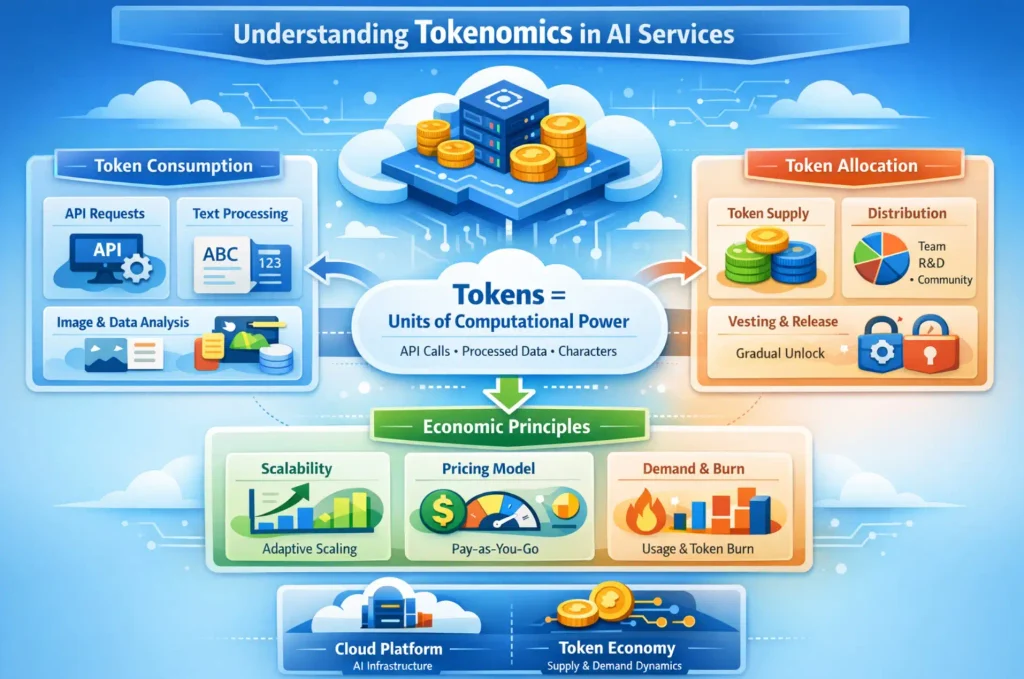
Tokens function as the basic unit of computational consumption across AI services.
Turning the Dials: Token Optimisation Across AWS, Azure and GCP
Every major hyperscaler gives engineering teams levers to pull once tokenomics is understood. On AWS, teams working with Amazon SageMaker can trim spend by batching inference requests, swapping in lighter-weight models, and tuning scaling policies so that inference capacity matches genuine demand rather than a worst-case guess. Azure takes a complementary path, pairing Azure Cost Management with AI-specific analytics that surface which workloads run hottest, letting architects shift towards lower-precision models or throttle request frequency where full-precision reasoning is not strictly needed. Google Cloud, in turn, gives teams near real-time visibility into token consumption through Vertex AI and Cloud Monitoring, making it straightforward to cap usage with quotas and steer traffic towards the most cost-efficient model endpoint for a given task.
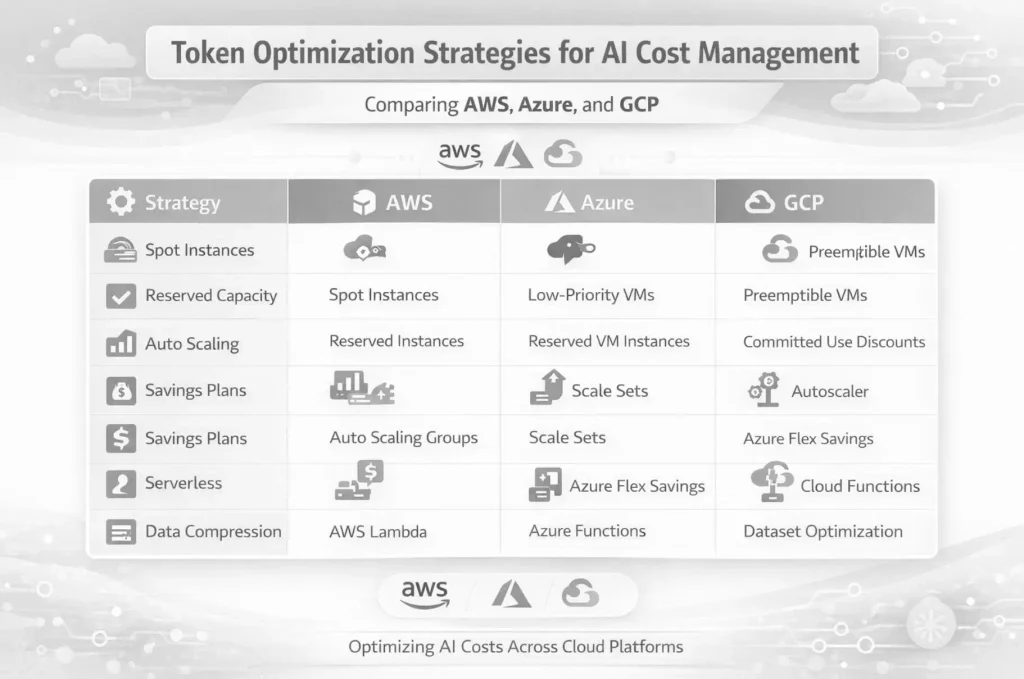
Comparable token optimisation strategies exist across AWS, Azure, and GCP, even where the underlying tooling differs.
None of these levers works in isolation, and the organisations that get the most out of them tend to treat optimisation as a recurring exercise rather than a one-off project: reviewing usage trends monthly, retuning model choices as traffic patterns shift, and automating scaling policies so that nobody has to remember to switch something off.
The FinOps Habits That Keep AI Spend Honest
Token optimisation solves the technical half of the problem; FinOps supplies the organisational half. A handful of practices consistently separate organisations that stay in control of AI spend from those that do not. Clear budgets, set at the level of a project or a product line, give teams something concrete to be measured against. Internal chargeback, allocating AI consumption costs back to the department or initiative that generated them, turns an abstract cloud bill into a number that someone genuinely owns. Encouraging judicious use of AI services, whether through batching non-urgent requests or defaulting to a lighter model unless the task demands otherwise, keeps consumption proportionate to value delivered. Automated alerts that fire the moment spend approaches a threshold buy finance and engineering the time to intervene before a spike turns into a crisis, and transparent reporting, delivered through dashboards rather than a quarterly slide deck, keeps everyone honest about where the money is actually going.
What This Looks Like in Practice
These principles are not theoretical. A fintech firm running fraud-detection models on Amazon SageMaker discovered, once it began watching token consumption closely, that a disproportionate share of spend was concentrated in a handful of peak hours. By resizing batches and introducing chargeback to the business units generating the traffic, the firm trimmed its monthly AI bill by roughly a fifth. A healthcare provider in India took a similar approach on Azure, pairing proactive budgeting with departmental transparency to catch unexpected spikes before they became budget overruns. And a retail business running customer-service chatbots on GCP’s Vertex AI found that auditing which model endpoint handled which type of query, rather than defaulting every conversation to the most capable option, delivered a meaningful reduction in token costs without any drop in service quality.
None of this requires reinventing FinOps from scratch. It requires extending the discipline most organisations already apply to compute and storage into a domain that bills differently and moves considerably faster. Tokenomics supplies the vocabulary; FinOps supplies the guardrails. Bring the two together, and AI spend stops being a source of anxiety and starts behaving like any other well-managed line item on the cloud bill.
References
- FinOps Foundation – FinOps for AI Overview – https://www.finops.org/wg/finops-for-ai-overview/
- AWS Cost Management – https://aws.amazon.com/aws-cost-management/
- Microsoft Azure Cost Management and Billing Documentation – https://learn.microsoft.com/en-us/azure/cost-management-billing/costs/overview-cost-management
- Google Cloud Vertex AI Pricing – https://cloud.google.com/vertex-ai/pricing
- FinOps Foundation – AI Technology Category – https://www.finops.org/framework/technology-categories/ai/