When Machines Manage the Money: How Agentic AI Is Rewriting Cloud FinOps
Cloud bills have never been easy to predict, but consumption-based pricing combined with the sheer scale of modern environments has made manual cost management feel increasingly like bailing out a boat with a teaspoon. Static rules and quarterly reviews simply cannot keep pace with environments that provision and de-provision resources by the minute. What is changing that equation is the arrival of generative and agentic artificial intelligence inside the FinOps function itself, not as a reporting add-on, but as an active participant in the day-to-day work of keeping cloud spend under control.
Two Different Kinds of AI, One Shared Goal
Generative AI and agentic AI solve different parts of the same puzzle. Generative models excel at synthesising large volumes of billing data into insight a human analyst might take days to produce, and at generating actionable recommendations from that analysis. Agentic AI goes a step further, deploying autonomous agents that do not just recommend an action but actually take it: adjusting a configuration, flagging an anomaly, or shutting down an idle resource without waiting for a ticket to work its way through a queue. Together, these two capabilities let FinOps shift from a reactive, after-the-fact discipline into something closer to a self-correcting system.
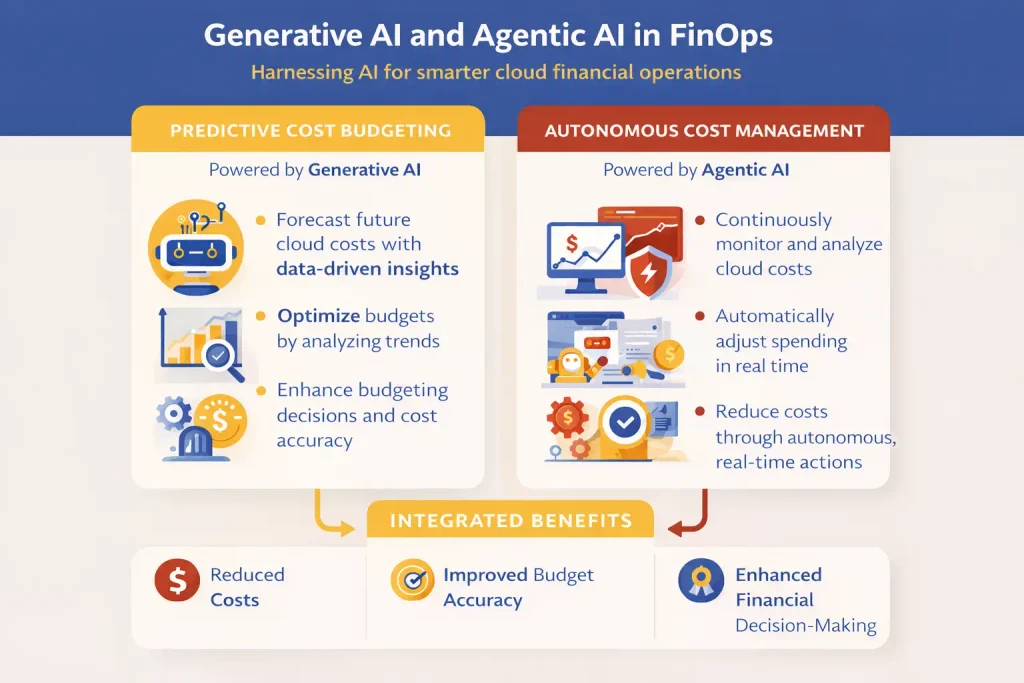
Generative AI strengthens predictive budgeting, while agentic AI drives autonomous, real-time cost management.
Autonomous Cost Management in Practice
The clearest sign of this shift is autonomous cost management: platforms that watch usage continuously, compare it against historical baselines, and flag the kind of anomaly a human reviewer would typically only spot weeks later, if at all. Systems built this way do not merely alert someone that an EC2 instance has sat idle for three days; they can resize it, reconfigure it, or terminate it outright, closing the loop between detection and action. The result is not just lower overhead for FinOps teams, but faster and more consistent decision-making, since the system is not waiting on someone’s calendar to free up.
Predicting the Bill Before It Arrives
Predictive cost budgeting applies the same intelligence to the future rather than the present. By training on historical consumption and layering in anticipated growth, generative models can produce budget forecasts, simulate a range of consumption scenarios, and warn stakeholders about a likely overrun long before the invoice lands. A retail business bracing for a seasonal shopping spike, for instance, can use AI-generated forecasts to lock in favourable reserved-instance pricing well ahead of the surge, rather than scrambling to negotiate once demand has already materialised.
Agents That Tag, Size and Report Without Being Asked
Perhaps the most tangible expression of agentic FinOps is the emergence of dedicated lifecycle agents. Tagging agents apply consistent metadata to every resource the moment it is created, closing off the usual escape route for orphaned, forgotten infrastructure that quietly accumulates cost. Sizing agents continuously compare actual utilisation against provisioned capacity, recommending, or directly executing, the right-sizing that a human reviewer would otherwise only reach during a periodic audit. Reporting agents distil the resulting data into dashboards that stakeholders can genuinely use, rather than raw exports nobody has time to parse.
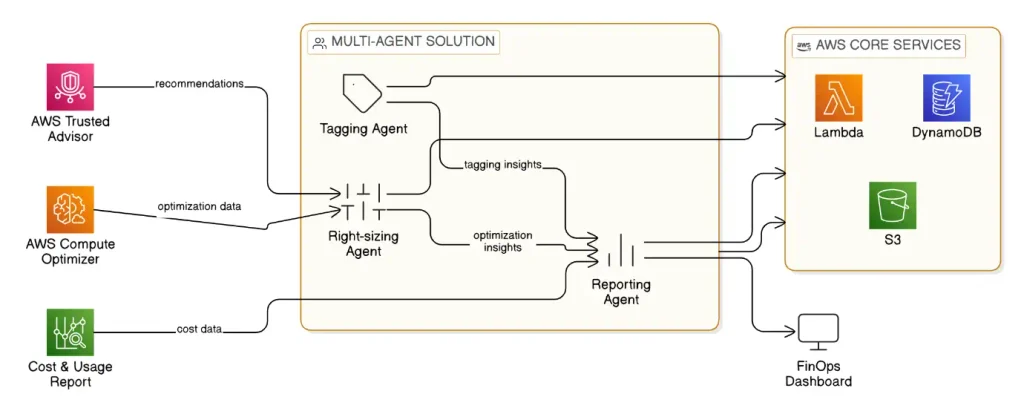
A typical AWS reference pattern: tagging, right-sizing, and reporting agents feeding a shared FinOps dashboard.
A typical AWS reference pattern connects these agents to Trusted Advisor recommendations, Compute Optimizer insights, and Cost and Usage Reports, orchestrating the whole pipeline through Lambda functions that feed a shared dashboard, turning what used to be a monthly scramble into an always-on process.
Where This Is Heading
The near-term trajectory is toward tighter collaboration between these agents. A tagging agent flags a resource for review, a sizing agent proposes a fix, and a remediation agent executes it, all without a human touching a ticket queue, and all orchestrated through the same automation fabric that already runs much of the cloud. As these systems mature, they will increasingly plug into the earliest stages of a project, applying cost-centre tags and budget thresholds automatically the moment a new initiative spins up, rather than after the fact.
Conclusion
The direction of travel is unmistakable: FinOps is moving from something teams do periodically to something the platform does continuously. Organisations that lean into agentic and autonomous cost management now will find themselves negotiating from a position of genuine cost discipline, rather than catching up after the fact, and that head start compounds with every quarter it is allowed to run.
References
- FinOps Foundation – https://www.finops.org/
- AWS Cloud Financial Management Blog – https://aws.amazon.com/blogs/aws-cloud-financial-management/
- Microsoft Tech Community – Managing the Cost of AI with FinOps – https://techcommunity.microsoft.com/blog/finopsblog/managing-the-cost-of-ai-leveraging-the-finops-framework/4381666
- AWS Trusted Advisor – https://aws.amazon.com/premiumsupport/technology/trusted-advisor/
- AWS Compute Optimizer – https://aws.amazon.com/compute-optimizer/