
FinOps for Containers: Comprehensive Guide to the Course, Assessment, and Career Opportunities
The exponential growth of container orchestration through Kubernetes across multi-cloud environments has transformed modern software architecture.
However, this technical flexibility introduces complex financial governance challenges. Opacity in shared costs, resource overprovisioning, and operational waste within microservices have driven the need for specialized disciplines like FinOps.
Table of Contents
What is FinOps for Containers?
FinOps for Containers is an intermediate, self-paced training course developed by the FinOps Foundation, designed to bridge the gap between cloud engineering and financial management.
Spanning approximately two to three hours, the program equips platform engineers, architects, and finance professionals with the practical strategies needed to gain granular cost visibility into multi-tenant Kubernetes environments. By teaching how to map raw infrastructure abstractions, such as CPU and memory requests, to specific applications, teams, or microservices, the course empowers organizations to eliminate idle waste, accurately allocate shared resource spend, and build a sustainable culture of financial accountability across containerized systems.
FinOps Kubernetes Program Change
This intermediate-level training program is designed to apply core financial principles directly to containerized environments. It imparts the skills required to master FinOps Kubernetes strategies, allowing teams to identify inefficiencies, build cost observability models, and allocate spend accurately across shared clusters.
Course Technical Overview
| Course Parameter | Technical Detail |
| Issuing Organization | FinOps Foundation / The Linux Foundation |
| Difficulty Level | Intermediate |
| Estimated Duration | 2 to 3 hours (self-paced) |
| Material Access | 12 months from enrollment |
| Credential Awarded | “FinOps Trained” digital badge (Credly) |
| Title Type | Training badge (course completion), no proctored exam |
It is essential to differentiate this course from other offerings in the FinOps Foundation portfolio. Unlike programs such as FinOps Certified Practitioner (FOCP) or FinOps Certified Engineer (FOCE), which require formal proctored exams.
FinOps for Containers awards the FinOps Trained status upon passing a multiple-choice quiz at the end of the modules.
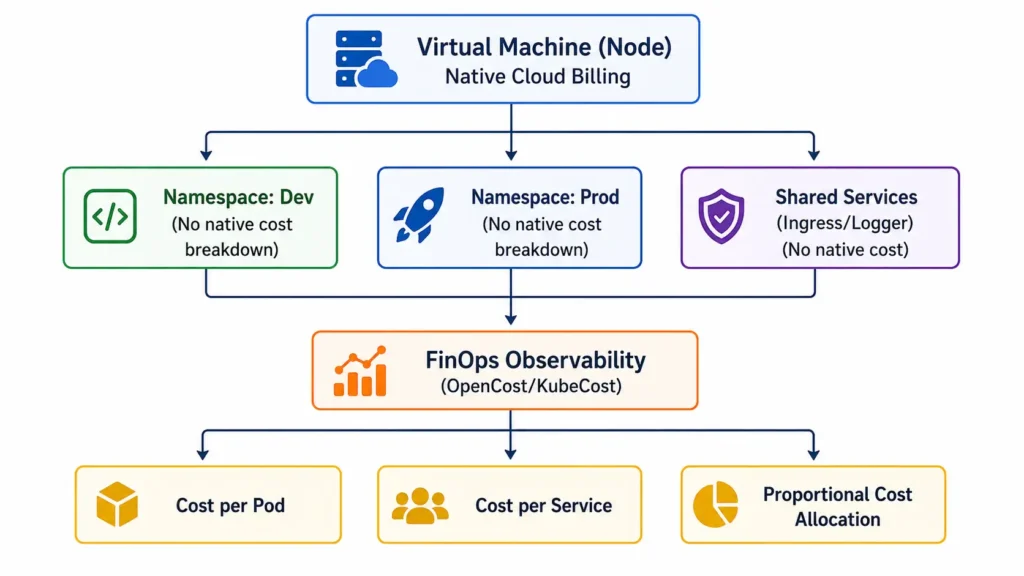
The main objective is to solve financial opacity in containerized infrastructure. While cloud provider invoices detail the aggregated cost of virtual machines acting as nodes, they do not break down costs by individual Pods, namespaces, or microservices by default. The training guides professionals in translating infrastructure abstractions (CPU, memory, storage volumes) into attributed costs for specific business units or applications.
FinOps for Containers price
Individual course enrollment costs $250 USD (reduced from its previous rate of $350 USD). This one-time payment grants 12 months of continuous access to all interactive modules, written materials, video lessons, and assessments.
Purchasing Options
| Purchase Option | Price (USD) | Scope and Inclusions |
| Individual Course | $250 | 12-month access to materials, videos, and final quiz. |
| Full Catalog Access | $2,495 | Access to FOCP, FOCE, AI Value, Technology Value, FinOps FOCUS Analyst, Professional, and Containers. |
| Corporate Subscriptions | Enterprise plan | Included in corporate training agreements for large IT teams. |
Global enterprises such as Capital One, Walmart, JPMorgan Chase, Apple, Bank of America, Mastercard, and SAP integrate this program into their internal development pathways to accelerate financial accountability across platform and infrastructure teams.
FinOps for Containers Discount Code
We are excited to announce that the FinOps Foundation has partnered with FinOps Weekly to offer an exclusive 20% discount on all FinOps certifications for our readers using our code FINOPSWEEKLY_20
You can use our dedicated community finops certified practitioner discount code at checkout to save instantly on your exam enrollment.
Discount Code: FINOPSWEEKLY_20
Curriculum Breakdown and Learning Path
The curriculum is structured across 16 sequential modules:
- FinOps for Containers Introduction
- The Case for FinOps
- Talking About Containers
- Transparency in Container Architecture
- Container Cost Overview
- Allocating in Shared Environments
- Finding Inefficiency
- Observability & Cost Attribution
- Engineering for Cost Efficiency
- Integrating Costs
- Use Case Examples
- Tools, Platforms, & Resources
- Container Terminology
- Categorization of Container Architectures
- FinOps for Containers Exam
- Course Feedback
Core Subject Blocks
| Subject Block | Modules Included | Primary Operational Content |
| Fundamentals & Communication | Modules 1 to 3 | Introduction to FinOps for containers, building business cases, and cross-departmental communication frameworks. |
| Architecture & Cost Allocation | Modules 4 to 6 | Architectural transparency, cost breakdown, and allocation strategies in shared multi-tenant environments. |
| Optimization & Engineering | Modules 7 to 9 | Waste detection, cost observability, attribution, and cost-efficient engineering design. |
| Integration & Practical Cases | Modules 10 to 14 | Integration with corporate accounting systems, real-world case studies, tooling, terminology, and categorization. |
| Assessment & Wrap-up | Modules 15 & 16 | FinOps for Containers course evaluation quiz and final feedback. |
Prerequisites and Key Strategies for Passing
- Working knowledge of AWS, Azure, or GCP concepts and terminology (preferably backed by a foundational or associate-level architecture certification).
- Familiarity with core Kubernetes abstractions such as clusters, pods, services, ingress controllers, and namespaces.
- Understanding of tagging/labeling best practices, consolidated billing accounts, and Spot/Preemptible instance usage.
Assessment Tips
The evaluation in Module 15 consists of multiple-choice questions designed to measure theoretical and analytical comprehension. To ensure a passing score, candidates should focus on mastering four core areas:
-
Requests vs. Limits: Understand how resource allocations translate to costs. Resource Requests reserve node capacity and represent the direct committed cost, whereas Limits define the operational execution ceiling.
-
Waste Identification: Spot common sources of inefficiency, such as idle capacity, overprovisioned resources driven by overly conservative estimates, improperly configured autoscalers (HPA/VPA), and orphaned persistent volumes.
-
Shared Cost Models: Master strategies for allocating non-attributable components (e.g., ingress controllers, monitoring agents, control plane nodes) using proportional, usage-based, or equal-share models.
-
Unified Language: Translate technical container metrics into financial terms that executive leaders can act upon without compromising system reliability.
Tooling Ecosystem and Complementary Resources
Theoretical concepts covered in the course map directly to open-source solutions and data standards widely adopted across the cloud-native industry:
OpenCost (CNCF): An open-source, vendor-neutral specification and measurement engine hosted by the Cloud Native Computing Foundation. It measures and allocates real-time infrastructure spending in Kubernetes by pod, service, and namespace via direct integration with cloud provider billing APIs.
KubeCost: A commercial solution built on top of the OpenCost engine, providing advanced features such as real-time alerting, budget tracking, and automated rightsizing recommendations.
FOCUS (FinOps Open Cost & Usage Specification): An open specification led by the FinOps Foundation aimed at standardizing cloud billing data across vendors. Adopting the FinOps FOCUS framework allows organizations to normalize container cost metrics and analyze Kubernetes expenses alongside traditional compute, storage, and database services within a single, unified dataset.
Enterprise Platform Integrations: Beyond public cloud engines like AWS EKS or Azure AKS, the framework extends seamlessly to enterprise distribution environments. Implementing FinOps OpenShift methodologies enables platform teams using Red Hat OpenShift to gain granular visibility into project-level cost management and multi-tenant resource quotas.
FinOps for Containers Community Feedback
Its primary limitation is that it focuses on conceptual understanding rather than hands-on practice.
Since it is delivered as a self-paced online course based on text and video content, it does not include lab environments or command-line exercises for deploying Kubernetes manifests.
For senior engineers who already operate OpenCost or KubeCost in production, much of the material may reinforce terminology and best practices rather than provide advanced implementation or performance tuning guidance.
Career Impact and Market Opportunities
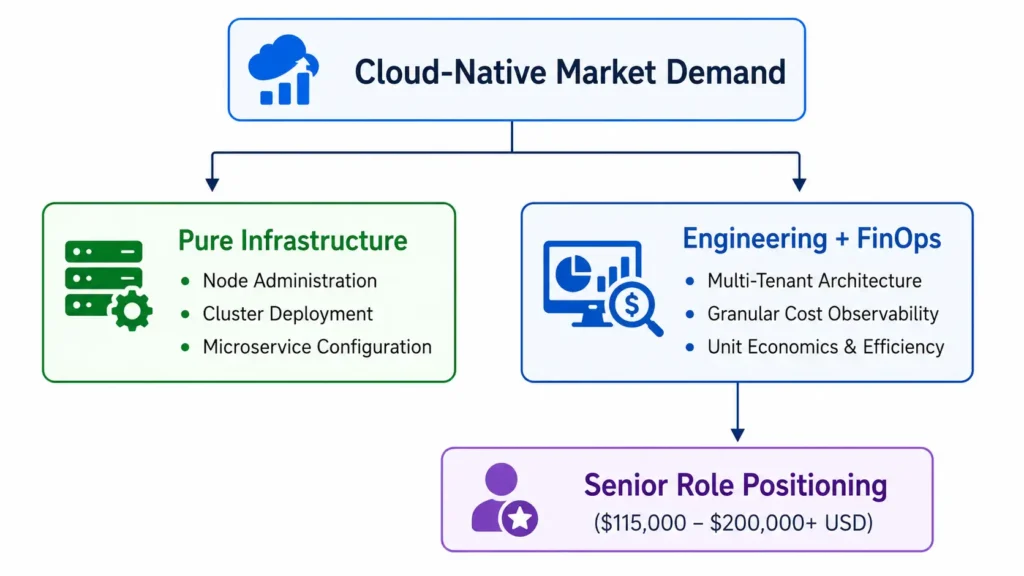
Cloud spend waste hovers around 29% across enterprises according to industry benchmark reports. Controlling Kubernetes operational costs has consequently shifted from a secondary task to an executive priority.
Application by Professional Role
| Role | Practical Application of Acquired Knowledge |
| Platform Engineer | Designs cost-efficient multi-tenant architecture and implements advanced FinOps Kubernetes frameworks to enforce resource quotas and granular chargeback. |
| Cloud Architect | For enterprise architects working with hybrid clouds, applying FinOps OpenShift strategies is becoming essential to control compute costs across both on-premises data centers and public cloud clusters.” |
| FinOps Practitioner | Bridges Kubernetes internal telemetry with corporate accounting workflows (Showback and Chargeback models). |
| Product Owner | Analyzes infrastructure costs per feature or client tier, enabling accurate Unit Economics calculations. |
In North American and European markets, senior professionals who combine cloud engineering skill sets (Kubernetes, Terraform) with FinOps expertise (such as Staff Platform Engineers or FinOps Technical Specialists) command compensation packages typically ranging between $115,000 USD and $200,000+ USD annually.
FinOps for Containers Certification
Completing this course grants a training badge, not a formal certification. If you are looking to earn official certification status, you must pass the exam for one of the primary FinOps credential paths: FinOps Certified Practitioner (FOCP), FinOps Certified Engineer (FOCE), FinOps Certified Professional, or FinOps FOCUS Analyst.
Its FinOps for Containers Worth it?
The FinOps for Containers course is a concise, accessible, and essential educational pathway for resolving cost opacity in containerized infrastructures. For $250 USD and roughly 3 hours of effort, it delivers the foundational concepts needed to transform complex cluster telemetry into actionable financial metrics.
To maximize its value, learners are encouraged to pair this theoretical knowledge with hands-on implementation of open-source tools like OpenCost, using the earned digital badge as a step toward advanced industry credentials such as FOCP or FOCE.
After earning the Containers badge, professionals looking to deepen their data specification skills often transition toward the FinOps FOCUS Analyst certification to master multi-cloud billing schemas.
Frequently Asked Questions
What exactly is the FinOps for Containers course?
It is an intermediate-level, interactive training program developed by the FinOps Foundation and The Linux Foundation. Its main goal is to teach tech and finance professionals how to accurately measure, allocate, and optimize infrastructure costs within containerized environments and Kubernetes clusters.
Does this course grant a formal certification?
No. Upon completing the modules and passing the final quiz, the course awards the “FinOps Trained” digital badge.
Unlike formal certifications such as FinOps Certified Practitioner (FOCP) or FinOps Certified Engineer (FOCE), this program does not require a proctored or supervised exam.
How long does it take to complete the training?
The course is designed for self-paced completion and takes approximately 2 to 3 hours, making it easy to finish within a single study session or work day.
How much does the course cost and what does it include?
The individual enrollment fee is $250 USD (reduced from its original price of $350 USD). The one-time payment includes 12 months of unlimited access to all interactive materials, readings, video lessons, and the final assessment on The Linux Foundation platform.
What prior knowledge is recommended before taking the course?
To get the most out of the content, candidates are recommended to have:
-
Cloud Fundamentals: Working familiarity with AWS, Azure, or GCP concepts (ideally at a Foundational or Associate level).
-
Container Basics: An understanding of core Kubernetes abstractions such as Pods, Namespaces, Services, and Ingress controllers.
-
Cloud Billing Concepts: Basic knowledge of tagging/labeling best practices, consolidated billing, and Spot/Preemptible instances.
Does the course include hands-on labs in live Kubernetes environments?
No. The training is 100% conceptual and methodological, focusing on financial governance, best practices, and establishing a unified language between teams. It does not feature command-line lab environments for deploying live Kubernetes manifests or configuring tools directly.
What FinOps ecosystem tools are covered or referenced in the course?
The course aligns its theoretical framework with industry-standard open-source and commercial solutions, including OpenCost (a CNCF open-source specification), KubeCost, the FOCUS data standard, and native cloud cost management tools such as AWS Cost Explorer, GKE Cost Allocation, and Azure Cost Management.
Which professional roles benefit most from this training?
It is ideal for Platform Engineers, Cloud Architects, DevOps Engineers, FinOps Practitioners, and Product Owners / Engineering Managers who need to understand how to attribute shared multi-tenant infrastructure spend back to specific business units, products, or applications.